Electrolyzers, fuel cells and hydrogen extraction equipment need a Korea Gas Safety Corporation (KGS) inspection before they can be sold or used in Korea, and the manufacturer abroad must register with the ministry. This guide puts the costs, forms, exemptions and penalties on one page, with a checklist for the first shipment.
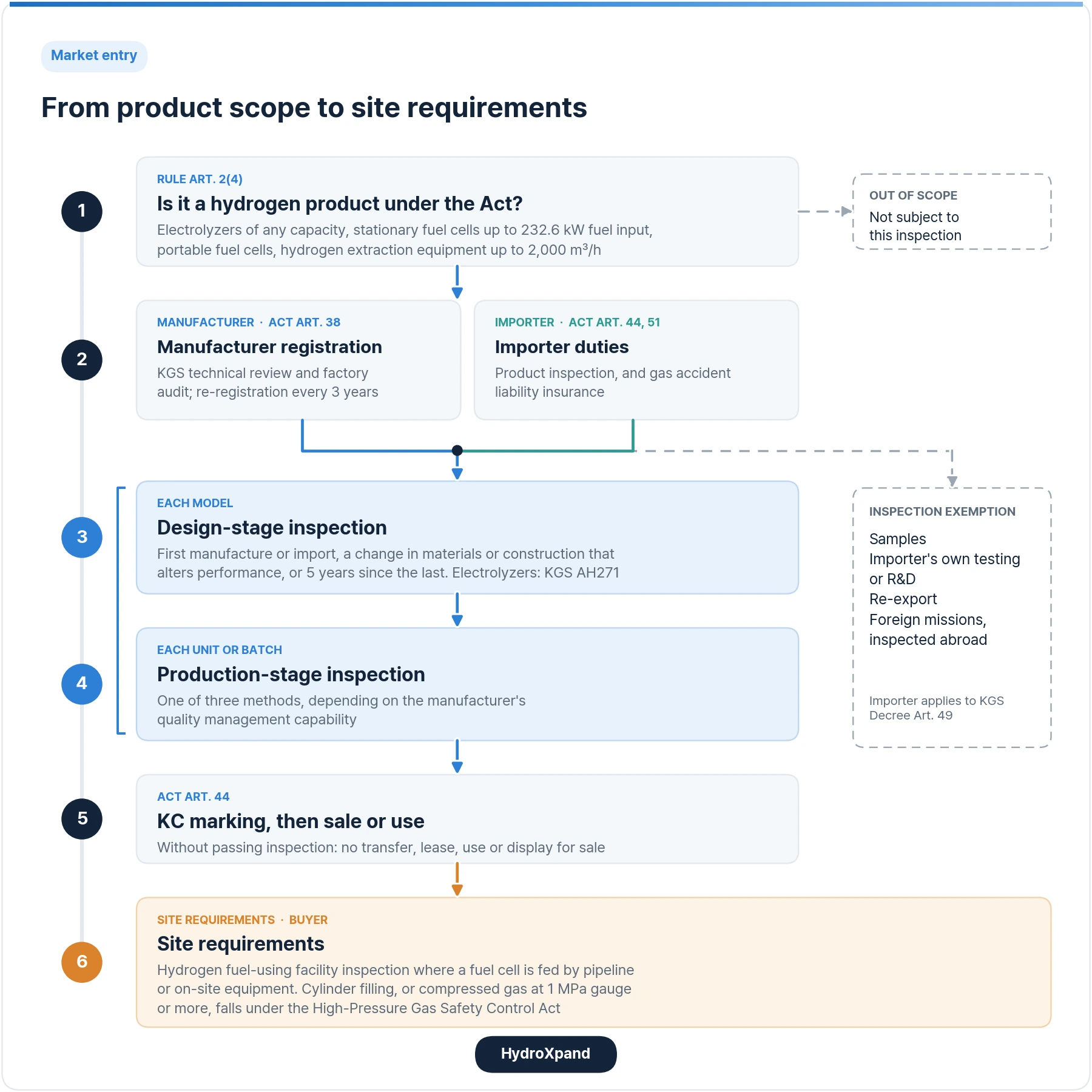
When a Korean customer asks whether your equipment is KGS certified, they mean the product inspection that the Hydrogen Act requires before a hydrogen product is sold or used. Electrolyzers, fuel cells and hydrogen extraction equipment are hydrogen products under the Act, and the Korea Gas Safety Corporation (KGS) carries out the inspection against a detailed code; for water electrolysis that code is KGS AH271. Strictly it is an inspection, not a certification: the voluntary KS equipment certification, brought into the Hydrogen Act in 2026, is a separate scheme and does not replace it.
This guide is based on the Act, its Enforcement Decree and Enforcement Rule as in force since 18 September 2026, the ministry's fee notice and the 2026 KGS codes. It is not legal advice; confirm the requirements for your product with KGS.
| At a glance | |
|---|---|
| What is required | KGS design-stage inspection of each model, then production-stage inspection of the units that follow, before sale or useAct Art. 44 |
| Who does what | The manufacturer abroad registers with the ministry after a KGS technical review and factory audit. The Korean importer or the registered manufacturer applies for inspection; the importer carries gas accident liability insuranceAct Art. 38, 44, 51 |
| Cost | Registration 25,000 won. Design-stage inspection 11,638,000 won for an electrolyzer, 16,634,000 won for a stationary fuel cell. Travel for inspection abroad is extraRule Annex 8; ministry fee notice |
| Time | Form processing periods: registration 5 days, technical review 15 days, factory audit 30 days. KGS publishes no overall timeline; add document preparation, testing and travelForms 11, 18, 28 |
| Exempt | Samples, imports for the importer's own testing or R&D, and re-exports, on the importer's application to KGSDecree Art. 49 |
| Not covered by KGS | KC electrical safety and KC EMC: confirm separately with KATS and RRA |
| If you skip it | Up to 1 year in prison or a fine of up to 10 million won; registration can be cancelledAct Art. 49, 59 |
A checklist before the first shipment
- Confirm the product is a hydrogen product under Rule Article 2(4), or that an exclusion applies.
- Register as a foreign manufacturer under Article 38, or confirm that an exemption applies, and agree with the importer who applies for inspection.
- If the shipment is a sample, for the importer's own R&D, or for re-export, have the importer apply to KGS for the exemption before it arrives.
- Check the design against the KGS code for your product; for electrolyzers, KGS AH271.
- Prepare the Korean application documents and plan the design-stage inspection.
- Check the marking: manufacturer, date, use, method of use, warranty period, serial number.
- Agree with the buyer how hydrogen will be used on site: direct supply, compression and storage, or cylinder filling.
- Ask KATS and RRA whether the product needs KC electrical safety or KC EMC certification.
Which products are covered, and which code applies
Article 2(4) of the Enforcement Rule names three kinds of hydrogen product. A product outside the limits does not go through this inspection at all.
| Product | Covered | KGS code (2026) |
|---|---|---|
| Water electrolysis equipment | Any capacity: alkaline, PEM, AEM | KGS AH271 |
| Stationary fuel cell | Fuel consumption up to 232.6 kW, with auxiliary equipment | KGS AH371 |
| Portable fuel cell | Any size, with auxiliary equipment | KGS AH372 to AH377, one per use |
| Hydrogen extraction equipment | Rated output up to 2,000 m³/h | KGS AH171 |
Excluded are fuel cells fitted to motor vehicles under the Motor Vehicle Management Act, educational fuel cells of 10 V output or less, educational electrolyzers of 20 V input or less, and equipment made or used to evaluate the performance of cells or stacks. The vehicle exclusion does not reach fuel cells in forklifts, ships or drones, and a system sold to produce hydrogen is a hydrogen product even if it sits in a lab. If a product is close to the line, ask KGS. The codes are published in Korean on the KGS code system.
SourceEnforcement Rule of the Hydrogen Act, Article 2(4); KGS code search, hydrogen field (law.go.kr; Korea Gas Safety Corporation)
Foreign manufacturer registration and importer duties
Article 38 of the Act says that a company that manufactures hydrogen products abroad for export to Korea must register with the Minister of Climate, Energy and Environment. Registration requires a business plan, a KGS technical review and a KGS factory audit, and is renewed every three years. A registered manufacturer may follow its own country's facility and technical standards where they meet items 1, 2 and 4 of Annex 1 of the Rule.
Registration is not required for products inspected by a foreign body recognised under a mutual recognition agreement, imports for the importer's own testing or R&D, re-exports, imports for foreign missions inspected abroad, samples, and products the ministry designates by notice as impractical to register (Rule Art. 27(1)).
There is no importer licence. The importer has the product inspected before sale or use, and carries gas accident liability insurance covering death, injury and property damage, with property damage cover of at least 100 million won per accident; imports not for sale and inspection-exempt imports are excused (Rule Art. 50(1)). Agree with the importer who applies for which inspection, and ask KGS how it treats a product from a manufacturer that has not registered. The nameplate of an imported product must name the seller in Korea.
SourceHydrogen Act, Articles 38, 44 and 51; Enforcement Rule, Articles 26, 27 and 50 (law.go.kr)
What KGS inspects
The design-stage inspection is a type examination of a model. It is needed when a model is first made or first imported, when a change in materials or construction alters its performance, and every five years. KGS checks materials, construction and dimensions, devices, performance and marking against the code. Parts with a test report from KGS or an accredited body can be spared re-testing, and an imported product is normally inspected at a place the importer chooses.
After that, each unit or batch goes through one of three production-stage methods, chosen by the manufacturer's quality management capability. A product that passes carries the KC mark, stamped into an electrolyzer; one that has not passed may not be sold, leased, used or displayed for sale.
| Production-stage method | What it involves |
|---|---|
| Product confirmation inspection | Quality inspection every 2 months, plus a sample inspection on each application |
| Production process inspection | Quality inspection and process audit every 3 months, plus unannounced inspections at least twice a year |
| Comprehensive process inspection | Audit of the whole quality management system every 6 months, plus an unannounced inspection at least once a year |
Under KGS AH271 the two process methods need at least three months of records from a documented quality management system.
SourceEnforcement Rule of the Hydrogen Act, Annex 1 (law.go.kr)
Exemptions
Article 49 of the Enforcement Decree exempts products made for export, imports for testing or R&D where the importer itself does the work, imports for foreign missions inspected abroad, samples, and imports for re-export. For imports the importer applies to KGS with evidence; the exemption is not automatic. The R&D case fits a Korean institute importing a unit to study it, but on its wording not a distributor importing for a customer's research.
For other imports, part of the inspection can be omitted where testing could degrade or damage the product, or where it has passed inspection by a foreign body recognised by the ministry.
SourceEnforcement Decree of the Hydrogen Act, Article 49; Enforcement Rule, Article 37 (law.go.kr)
Forms, fees and processing periods
The forms are in Korean and most go to KGS. A Korean importer or agent usually files them, but the drawings, process chart and test data come from the manufacturer, so allow time for translation. The processing periods on the forms are the authority's handling time once a complete application is in.
| Step | Form, to | Fee (KRW) | Period on the form |
|---|---|---|---|
| Technical review: installation plan, drawings against the standards, process chart | Form 28, KGSRule Art. 22(3) | Under the High-Pressure Gas Safety Control Act | 15 days |
| Factory audit: the same three documents | Form 18, KGSRule Art. 27(3) | Statutory; amount not in the fee notice | 30 days |
| Registration: business plan, review report, audit report | Form 11, ministryRule Art. 22(2) | 25,000, also for re-registration; change of registration 15,000 | 5 days |
| Design-stage inspection | Form 25, KGSRule Art. 36 | Electrolyzer 11,638,000; stationary fuel cell 16,634,000; portable fuel cell 11,069,000; extraction 16,756,000 | 7 days, the same for every inspection |
| Production-stage inspection | Form 25, KGS | Electrolyzer, per application: 78,000 to 274,000 by size. Process methods, first and renewal: 3,020,000 or 4,540,000 | |
| Exemption | Form 26, KGS, by the importerRule Art. 37(1) | None | 7 days |
The 7 days on Form 25 is the processing period for any inspection application; real design-stage testing takes longer, and KGS publishes no overall timeline. For inspection abroad the applicant also pays travel, test materials and any overtime surcharge. Fees are from the ministry notice on inspection fees for hydrogen gas facilities as published on law.go.kr in November 2026; check the current notice before budgeting.
Source수소가스시설 등의 검사수수료 및 교육비 기준 (ministry notice on inspection fees); Enforcement Rule, Annex 8 and Forms 11, 18, 25, 26, 28 (law.go.kr)
What KGS AH271 asks of an electrolyzer
KGS AH271 covers alkaline, acidic, AEM and PEM electrolyzers with no capacity or pressure ceiling, from the feed water valve to the first connection on the hydrogen outlet. A few requirements shape the design more than the rest.
| Requirement | What the code requires |
|---|---|
| Emergency stop | Among the conditions: hydrogen in the enclosure above 1%, oxygen in hydrogen above 3%, hydrogen in oxygen above 2%; manual restart onlyAH271 3.3.1.2 |
| Purge and ventilation | Purge before start; keep flammable gas in the enclosure below a quarter of the lower flammability limitAH271 3.3.1.1, 3.2.10.2 |
| Enclosure protection | IP2XC indoors; IP24 outdoors, including parts mounted outside the enclosureAH271 3.4.3.4.3 |
| Hydrogen quality | Fuel cell supply: the Korean fuel cell hydrogen standard. Other uses: oxygen ≤ 50 µmol/mol, moisture ≤ 5 µmol/mol, or ≤ 50 at 5 MPa or lessAH271 3.4.4 |
| Electromagnetic immunity | Electrostatic discharge, fast transients, surge and conducted RF testsAH271 3.4.3.6 |
| Nameplate | 17 items, including use (fuel cell or other), rated production rate, pressure, efficiency and, for imports, the sellerAH271 3.6.1 |
- Reading a hydrogen purity specification→Percent, nines, dew point, and the dryer behind them.
After the sale
Every hydrogen product must be marked with the manufacturer, date, use, method of use, warranty period and serial number (Act Art. 45(3)). The authorities can collect products on the market, normally within a year of inspection or within the warranty period, and order a recall, exchange or refund if they find a serious defect (Act Art. 45(1)). Modifying a product in a way that changes its construction or performance is prohibited.
| Violation | Penalty |
|---|---|
| Not having a product inspected, as a Korean manufacturer or an importer; or selling, leasing or using an uninspected product | Up to 1 year in prison or a fine of up to 10 million wonAct Art. 59(2) |
| Missing the required marking | Up to 6 months in prison or a fine of up to 5 million wonAct Art. 59(3) |
| Modifying a product for sale | Up to 5 years in prison or a fine of up to 50 million wonAct Art. 58(1) |
| No liability insurance | An administrative fine of up to 3 million wonAct Art. 62(2) |
The company is fined alongside an employee who commits one of these offences, unless it supervised with due care (Act Art. 61). A registered foreign manufacturer that sells without inspection, ignores a recall order or misses markings can have its registration cancelled or its imports restricted for up to six months (Act Art. 49(3)).
SourceHydrogen Act, Articles 45, 49 and 58 to 62 (law.go.kr)
Site requirements
The buyer's site has its own rules. Where a stationary fuel cell is fed by pipeline or from on-site hydrogen equipment, the piping and equipment form a hydrogen fuel-using facility under Article 47 and KGS FU671, with a completion inspection before use and periodic inspections every 6 or 12 months. Compressed gas at 1 MPa gauge or more is high-pressure gas, and filling cylinders or vehicle tanks with hydrogen at that pressure needs a licence under the High-Pressure Gas Safety Control Act. Agree the intended use with the buyer before choosing the outlet pressure.
KC electrical safety and KC EMC sit outside the Hydrogen Act. The official product lists do not name electrolyzers or fuel cells but include catch-all categories, so confirm with the Korean Agency for Technology and Standards (KATS) and the National Radio Research Agency (RRA).
HydroXpand makes AEM electrodes, stacks and electrolyzer systems in Korea and works with KGS under the same Act. If you are planning to bring hydrogen equipment into Korea, we would be happy to talk through the requirements with you.
- Before the electrolyzer arrives: the site checks that decide your schedule→Exhaust routes, ventilation, power and water.
- Korea's Hydrogen Act: what the 2026 amendment changes→KS certification, insurance and support measures.
Frequently asked questions
Do I need KGS certification to sell an electrolyzer in Korea?
You need KGS inspection, which is what Korean buyers usually mean by certification. Electrolyzers of any capacity are hydrogen products under the Hydrogen Act, and Article 44 requires the manufacturer or importer to have them inspected by KGS before sale or use.
How much does KGS inspection cost?
Under the ministry's fee notice, a design-stage inspection costs 11,638,000 won for an electrolyzer and 16,634,000 won for a stationary fuel cell. Foreign manufacturer registration costs 25,000 won. Travel for inspection abroad is paid by the applicant on top.
Does a foreign manufacturer have to register?
Yes. Article 38 of the Act requires a manufacturer abroad that makes hydrogen products for export to Korea to register with the Minister of Climate, Energy and Environment after a KGS technical review and factory audit, and to re-register every three years. Samples, the importer's own R&D imports, re-exports and a few other cases are exempt.
Does the importer need a licence?
No. The importer has the product inspected before sale or use and carries gas accident liability insurance, unless the import is not for sale or is inspection-exempt.
Can I send a sample or a research unit without inspection?
Yes, if the conditions are met and the importer applies to KGS. Samples, imports that the importer itself tests or develops, and re-exports are exempt.
What happens if a product is sold without inspection?
The importer or Korean manufacturer, and anyone who sells, leases or uses the product, can face up to one year in prison or a fine of up to 10 million won, and the company can be fined too. A registered foreign manufacturer can lose its registration or have its imports restricted.
Do electrolyzers need KC electrical or EMC certification?
It depends on the product. The official lists do not name electrolyzers or fuel cells but include catch-all categories, so confirm with KATS and RRA. KGS AH271 includes its own electromagnetic immunity tests.
Sources
- 수소경제 육성 및 수소 안전관리에 관한 법률 (Hydrogen Economy Promotion and Hydrogen Safety Management Act), Act No. 21467 — Korea Ministry of Government Legislation, law.go.kr
- Enforcement Decree of the Act, Presidential Decree No. 36587 — law.go.kr
- Enforcement Rule of the Act, Ordinance No. 56 of 31 August 2026 — law.go.kr
- 고압가스 안전관리법 시행령 (Enforcement Decree of the High-Pressure Gas Safety Control Act) — law.go.kr
- Hydrogen Economy Promotion and Hydrogen Safety Management Act, English translation (as amended by Act No. 18889) — Korea Legislation Research Institute Earlier consolidation; the 2026 amendment is not yet translated.
Looking at AEM for a specific application?