Enquiries often start with the wrong question: which model for the lab, or whether a test rig can simply be scaled up. Research and industrial equipment differ in more than size. One is bought to produce data and the other to produce hydrogen, and that decides what to check, what arrives in the box and how long it takes.
Two questions come up again and again in enquiries. Which product should a laboratory be looking at? And can the test rig already on the bench simply be made bigger?
Both assume the difference between research and industrial equipment is size. Size does differ, but the criteria you choose by differ first, and so does what the supplier actually hands over.
This page sets the two side by side: what each is for, what to check on each side, where the supply boundary falls and how lead times follow from it. The detail for each side lives in separate articles, linked as we go.
The split is purpose, not size
A research electrolyzer runs to produce data. Is the new catalyst better than the old one? How much does the voltage drop when the membrane changes? The hydrogen itself hardly matters. What matters is that a condition can be repeated exactly, and then changed one variable at a time.
An industrial electrolyzer runs to produce hydrogen. Does enough come out, does it keep coming out at the same rate all day, and how much electricity does each kilogram take? Changing conditions often is a problem here, not a feature.
Almost everything else follows from that. Research equipment is built so that things can change. Industrial equipment is built so that they do not.
A research instrument has to be changeable. A production machine has to stay the same.
What each side has to check
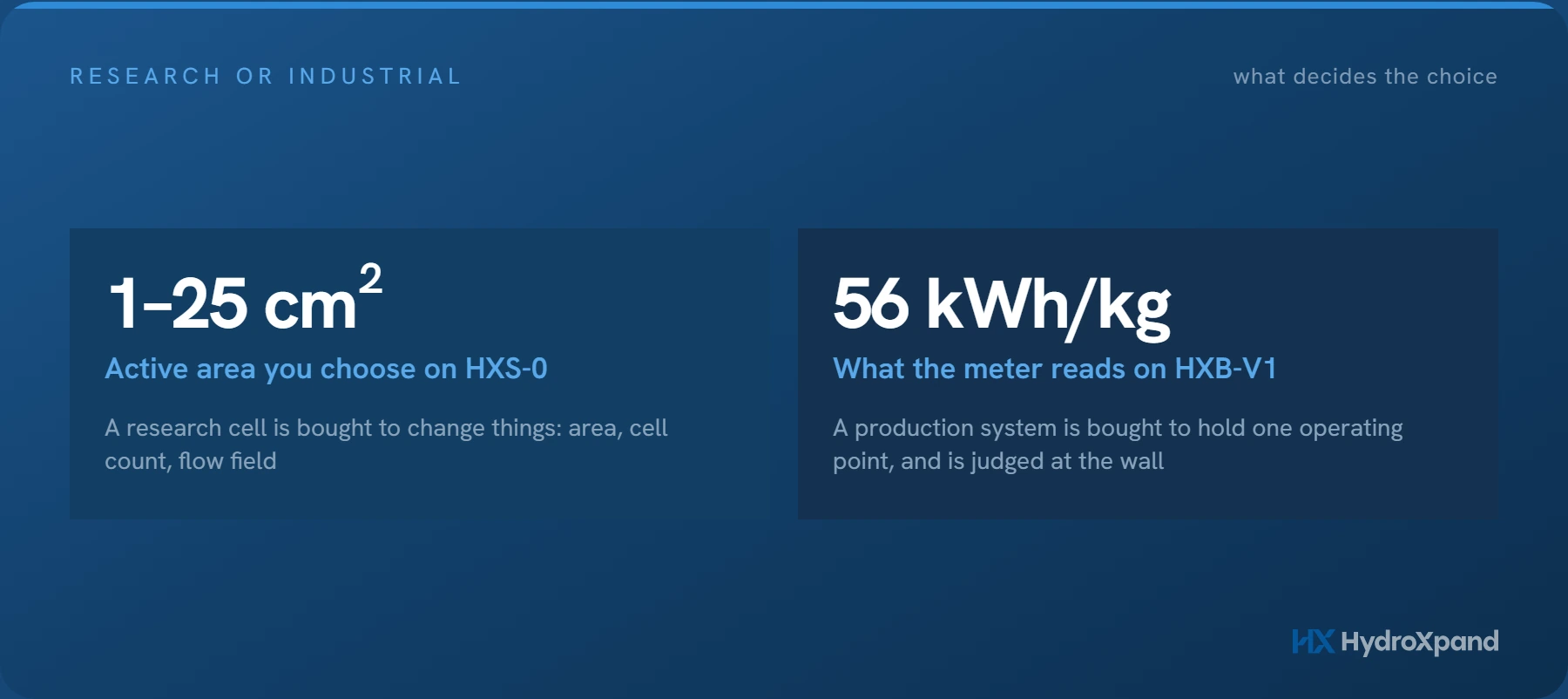
On the research side, four questions decide most purchases. Can the active area and cell count be set for your experiment? HXS-0 runs from 1 to 25 cm², single cell to 20 cells, and is made to order once those are fixed. Will it accept your own membrane or catalyst? The standard cell ships without an MEA for exactly that reason. Can electrodes be bought on their own, a sheet at a time? And is enough published about the material to write a methods section?
That last one catches people. We publish the structure and the test conditions: HXP-an is NiFe layered double hydroxide grown directly on nickel foam, HXP-ca is Pt/C or PtRu/C at 0.2 mgPGM/cm². We do not publish the composition or the process, and it is better to know where that line sits before the paper is drafted.
On the industrial side the questions are different. How much comes out: HXB-V1 makes 480 NL/h, about 1 kg a day. What it costs to run: the HXS-2 stack measures 90.0% HHV, about 44 kWh/kg, at beginning of life in 0.1 M KOH at 50 °C, and the complete HXB-V1 draws 56 kWh/kg at the wall. How long it holds: HXS-2 has more than 3,000 hours of cumulative operation, and its long-run data is published with the test conditions. And how much of the plant you have to build yourself, which is the next section.
| Research | Industrial | |
|---|---|---|
| Runs to get | Data | Hydrogen |
| Conditions | Changed deliberately,one variable at a time | Fixed and held |
| Judged by | Repeatability andwhat can be swapped | Output, kWh per kg,hours at the same performance |
| Typical run | Often a few hours | Thousands of hours |
| Usually bought as | Electrodes or a test cell | A stack or a system |
SourceU.S. DOE Technical Targets for Liquid Alkaline Electrolysis (kWh/kg, degradation, lifetime)
Where the supply boundary falls
The word electrolyzer gets used for all of it. In a purchase order the useful distinction is how far the supply goes, and not knowing it is how someone buys a stack and then cannot make hydrogen with it.
- Electrodes (HXP-an, HXP-ca): the material, by the sheet. Everything else is yours.
- Stack (HXS-2, HXS-30): MEAs, bipolar plates and end plates clamped into the reacting unit. Power, electrolyte circulation, gas-liquid separation and the safety system are designed and added by you.
- System (HXB-V1): the stack with its balance of plant in one unit. Connect power and water and hydrogen comes out.
Research usually ends at electrodes or a test cell. Industrial buyers split between a stack and a system, and the deciding question is whether the team can design the balance of plant. If it can, a stack is the cheaper route. If it cannot, the system is the right purchase.
The warranty follows the same line. The 12-month warranty sits on the HXB-V1 system; electrodes and stacks are supplied against their published specification and outgoing inspection. The tier-by-tier detail is in our article on buying components.
Lead times and terms
Lead times grow with how much is being assembled, and they all count from order acceptance rather than from the enquiry.
- Electrodes: 2 weeks for standard formats, up to about two months for custom thickness or size.
- HXS-0 research cell: 4 weeks once the active area, cell count and flow field are fixed.
- HXS-2 stack: 4 weeks. The 46-cell HXS-30 is available now and under long-term evaluation; ask for its lead time with the enquiry.
- HXB-V1 system: 8 weeks.
Our base term is EXW, and other Incoterms such as DAP can be arranged. Goods originate in Korea and come with a certificate of origin.
Research budgets often have to be spent by a fixed date. If yours does, check the lead time before the specification, because a custom electrode can take most of a quarter.
Where lab results fail to carry over
We make both kinds, so we see the same thing repeatedly: a result that looked good in research does not survive the move to production.
An electrode that performs well in a small cell loses ground once the area grows. A condition that held for a few hours comes apart after a few hundred. Area and time are the two things that change on the way up, and each one brings problems the smaller test never showed.
Our own platforms show the scale of that step. The HXS-0 cell tops out at 25 cm², the HXS-2 anode is 100 cm² and the HXS-30 anode is 600 cm². And the clock starts again at each new size: HXS-2 has thousands of hours behind it, while the HXS-30 record so far is 293 hours on a 15-cell short stack and a first published 96.7 hours on the 46-cell full stack.
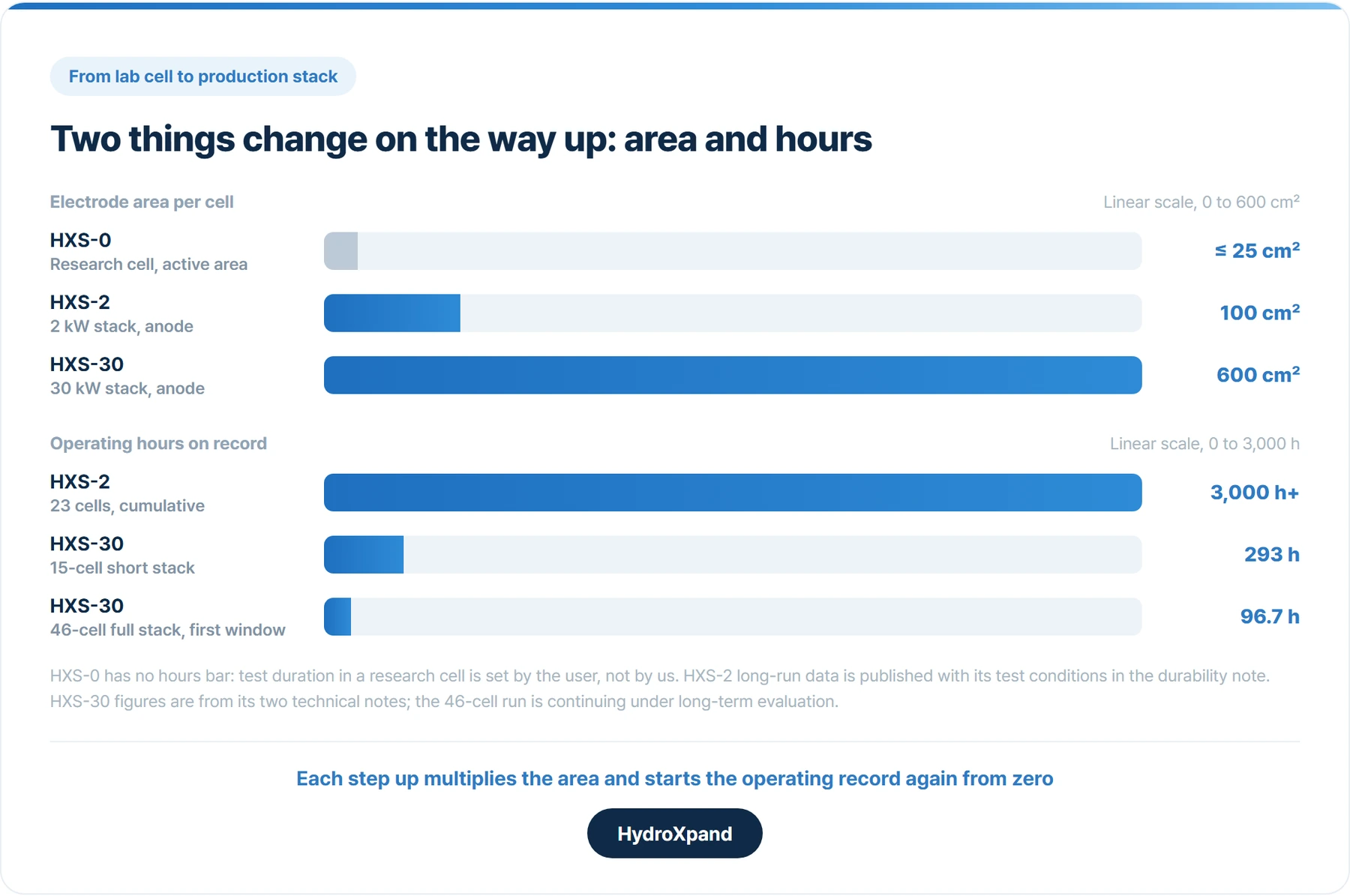
A result covers the area and the hours it was measured at. Scaling up changes both.
So even when buying for research, it is worth asking about the next step. Can the material you are validating now be made at a larger area later, and does the same supplier make the tier above? That is why we build electrodes, stacks and systems from the same materials.
- What is an electrolyzer stack→What a stack is made of, how cell count scales output, and what decides performance.
- Buying AEM components→The research side in detail: electrodes, test cells and stacks bought separately.
- Choosing an AEM test cell→Active area, cell count and flow field, before you order a research cell.
- What turnkey includes in a 2 kW electrolyzer→The industrial side in detail: what one system contains and what the site provides.
- What an electrolysis system is→Why 44 kWh/kg at the stack becomes 54 at the wall.
- Reading stack durability data→HXS-2 long-run data, with its test conditions.
- The 46-cell HXS-30 full stack→What the first 96.7 hours at 600 cm² showed.
- Between one and fifteen kilograms a day→When one system is not enough.
Frequently asked questions
Is the difference between research and industrial electrolyzers just size?
No. A research electrolyzer runs to produce data and has to let conditions change, while an industrial one runs to produce hydrogen and has to hold its conditions for thousands of hours.
Does buying a stack mean I can make hydrogen straight away?
No. A stack is the reacting unit only; power, electrolyte circulation, gas-liquid separation and the safety system have to be added, and a system such as the HXB-V1 already includes them.
What are the lead times for electrodes, stacks and systems?
From order acceptance, standard electrodes take 2 weeks, the HXS-2 stack 4 weeks and the HXB-V1 system 8 weeks. The HXS-0 research cell takes 4 weeks once its specification is fixed.
Sources
- EU harmonised accelerated stress testing protocols for low-temperature water electrolyser, EUR 31748 EN — European Commission Joint Research Centre, 2024
- Technical Targets for Liquid Alkaline Electrolysis — U.S. Department of Energy
Looking at AEM for a specific application?