A long durability test is not a replacement interval, and no stack holds its performance forever. What sets the multi-year cost is the unit of replacement: the whole stack, or only the MEA that wears. How that works on HXS-2, where the warranty stops, and what opening a stack yourself takes.
Most electrolyzer comparisons start with the purchase price, which is reasonable. If the equipment is going to run for several years, though, what has to be replaced in that time, and how often, weighs on the budget almost as much as the first invoice.
No stack keeps its performance forever, so the useful question is what gets replaced when it needs attention, and what gets used again.
What wears first
A stack is a pile of cells clamped between two end plates. The reaction happens in the membrane electrode assembly, the MEA, where the electrodes are pressed onto the membrane. Current, electrolyte and gas all pass through it, and that is where performance change starts.
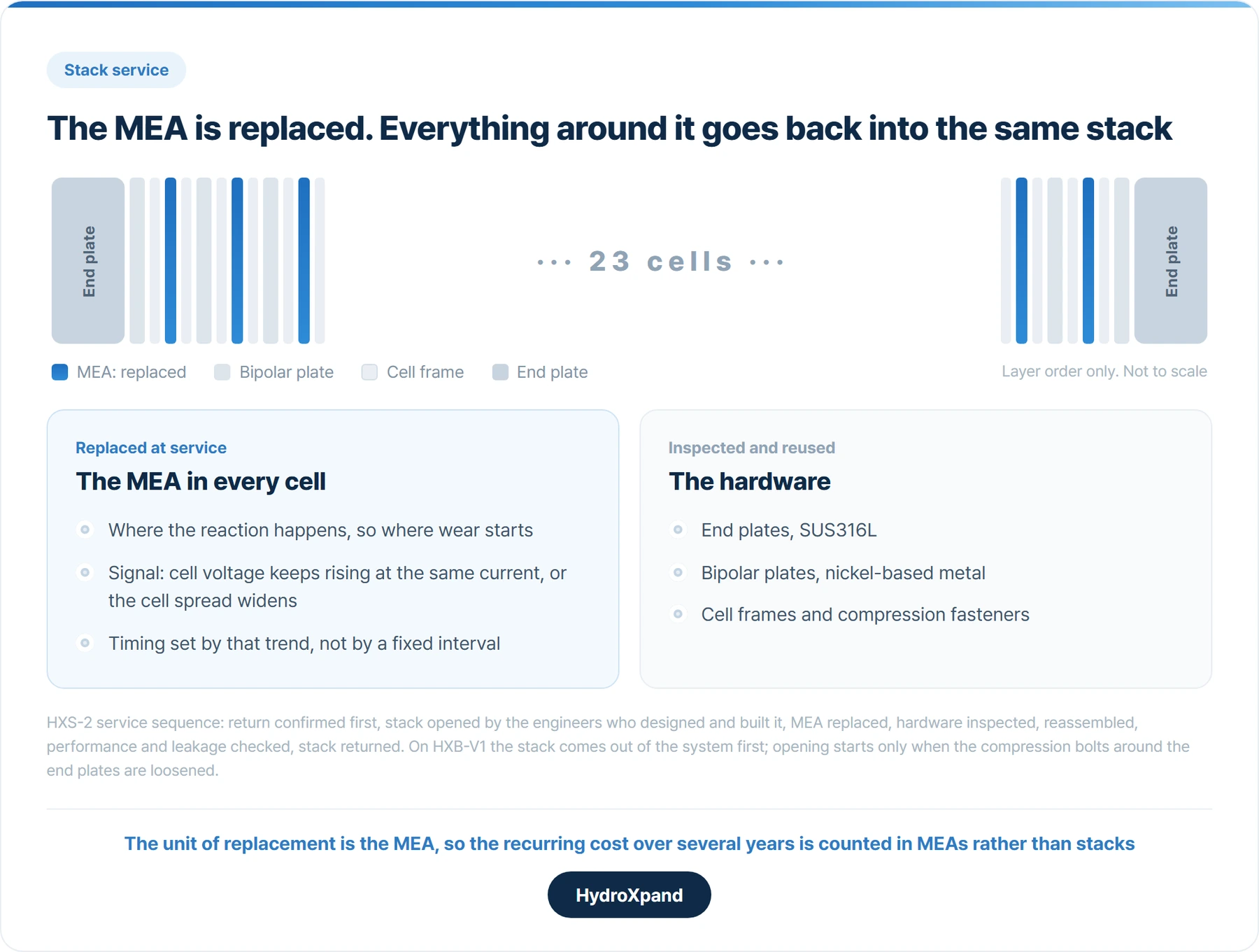
The rest of the stack is hardware that takes no direct part in the reaction: end plates, bipolar plates, cell frames and the compression fasteners. It does not wear at the rate the MEA does, which is what makes it reusable.
Wear shows up in the operating record first: at the same current the cell voltage keeps climbing, or the spread between cells widens. A new MEA also moves while it settles, so read the record in three parts: the initial change, the stable period, and the trend after it.
One gas indicator sits apart from all this. If hydrogen in the oxygen exceeds 2%, the stack is stopped and inspected before it restarts. That is a safety condition, not a replacement criterion.
A test length is not a replacement interval
Our long-run HXS-2 data shows how a 23-cell stack behaved at one stated set of test conditions, without a clear acceleration in voltage degradation. It says nothing about how long an MEA lasts at higher temperature, through repeated start and stop, under pressure or on a renewable load, and we do not extend the line past the hours we measured.
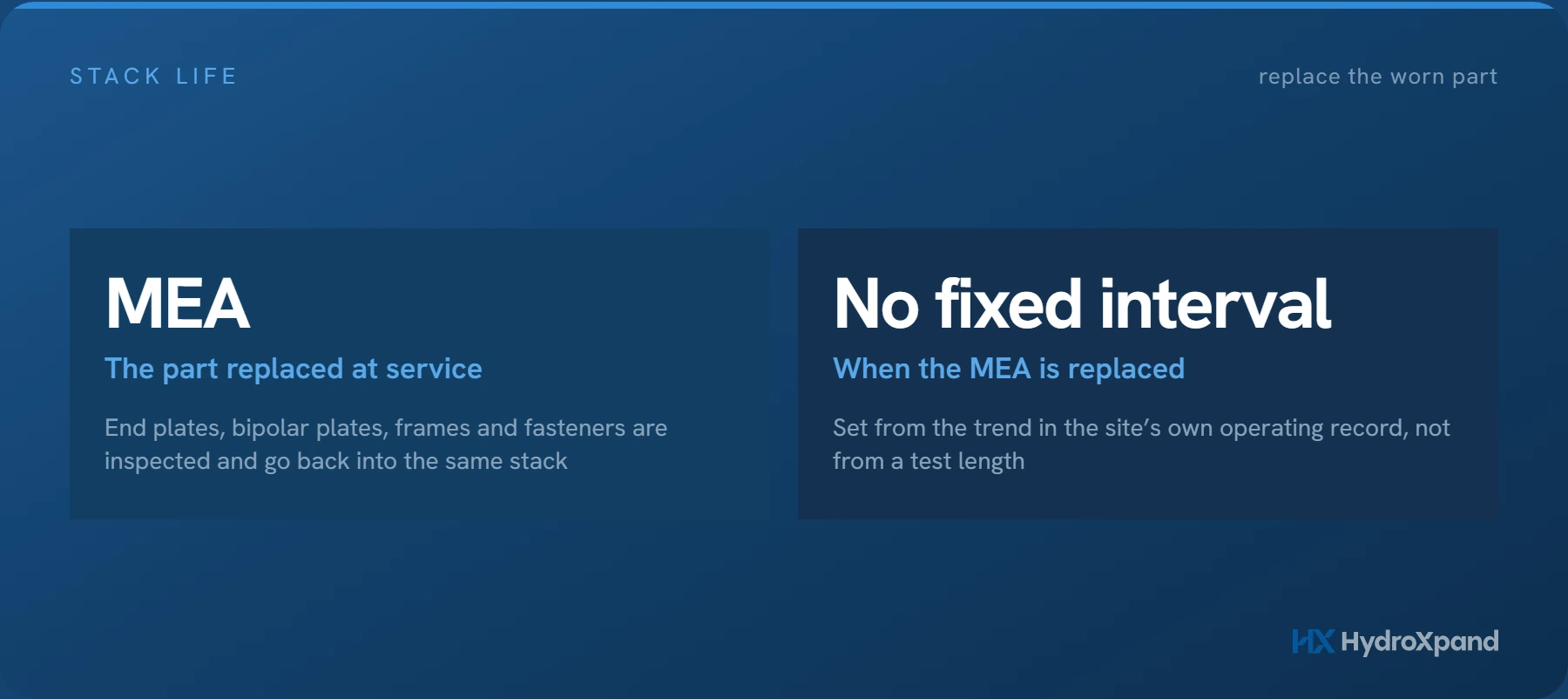
So replacement timing is not a fixed interval. It varies widely with operating conditions and gets shorter as temperature, electrolyte concentration and current go up. The service point is set from the trend in the site's own record. For a recommended range, send us your conditions.
A durability test tells you what a stack did under stated conditions. The replacement point comes from your own operating record.
SourcesU.S. DOE Technical Targets for Liquid Alkaline Electrolysis (end-of-life convention) (a target-setting convention, not our replacement criterion) · JRC: EU harmonised polarisation curve test method for low-temperature water electrolysis (2018)
Replacing the stack, or replacing the MEA
Two stacks bought at the same price can cost quite different amounts over several years. Where the unit of replacement is the whole stack, a worn MEA means buying the hardware again along with it. Where it is the MEA, the hardware goes back into service.
HXS-2 is built the second way. It is a compression assembly, so it can be taken apart. At service the stack comes back to us, and the engineers who designed and built it open it, replace the MEA, inspect the hardware, reassemble it and check performance and leakage before it goes back.
The 2 kW system, HXB-V1, holds the same removable stack, so the route is the same. Removing the stack is not opening it, though. The bolts around the end plates are the compression bolts, and opening begins when those come loose.
| Whole stack replaced | MEA replaced (HXS-2) | |
|---|---|---|
| Unit of replacement | The stack | The MEA |
| End plates, bipolar plates, frames, fasteners | Bought again | Inspected and reused |
| What comes back | A new stack | The same stackchecked for performance and leakage |
| Recurring cost | The whole stack each time | MEAs and agreed consumables each time |
Returns go ahead only after we confirm them, so ask before shipping and keep the original packaging if you can. The scope and terms of the service are fixed in the quotation.
Where the warranty stops and service starts
The HXB-V1 system warranty runs 12 months from the date of shipment, or from acceptance where an acceptance procedure applies. It covers defects in materials or workmanship present at delivery. Normal wear of consumables, meaning the MEA, gaskets and O-rings, is excluded, although a defect in them at delivery is still covered.
Performance loss from operation is therefore not a defect. It is handled as paid stack service: the MEA is replaced, the hardware is reused, and functional checks follow. For six months after a paid replacement we warrant the workmanship and the replaced parts, though not the normal degradation over those months.
For a bare HXS-2 bought for your own system, the terms are agreed in the quotation rather than taken from the system warranty.
What it costs over several years
Over several years the cost has three parts: the purchase, periodic MEA replacement, and electrolyte and consumables. The replaceable-MEA design changes the second part, which is then counted in MEAs rather than stacks.
The electrolyte is not changed on a schedule either. Electrolysis consumes water, not KOH. HXB-V1 tops the water up automatically from its internal pump; on a bare stack your own balance of plant does it. Replacement is considered when the cell voltage keeps rising at the same current, when the spread between cells widens, or when the electrolyte changes colour or clarity or shows precipitate.
Day-to-day upkeep is mostly observation: water supply, leaks, operating data and electrolyte condition. Recording those four is what lets you read a trend, and gives a baseline for the stack when it comes back.
Where supply cannot stop, a spare stack covers the service period. HXS-2 is also supplied as a spare or replacement stack for existing systems, so one keeps running while the other is with us.
Over several years, what you replace matters about as much as what you paid.
Opening the stack yourself
Research buyers often want to look inside. The stack is built to be opened, and stack customers receive the reassembly guide, but it takes the right equipment.
You need a hydraulic press and the dedicated tooling. Performance and sealing hold only if the specified compression and bolting sequence is followed, and those values are in the guide. If you have no press, tell us before you open the stack and we will work out an approach with you.
Gaskets are where it usually goes wrong. The O-ring rides out of its seat and the MEA gasket shrinks inward, so both have to be seated after clamping.
Reassembly quality decides performance and leakage, so the warranty line falls there too. We do not warrant performance or leak-tightness after a customer has opened the stack; a defect identified before opening stays covered. If you want us to look at a stack after you reassemble it, arrange that before opening; it is a service, not a warranty claim.
Four questions to put to any supplier
If the plan is to run a stack for several years, these are worth asking whoever you buy from.
- Are there disassembly and reassembly instructions? Without them every service goes back to the supplier.
- Which hardware is inspected and reused at MEA replacement? That defines what a service actually covers.
- How are performance and leakage confirmed before a serviced stack comes back?
- Where does the warranty end and consumables begin, and how is performance loss handled?
A specific answer to each is the test. Ours: the reassembly guide covers the first, the service scope and terms are fixed in the quotation, and the durability note explains how to read the long-run data behind all of it.
- Is AEM electrolysis proven?→What the published run covers and what it does not, as a question of maturity.
- The durability dataset→The long-run HXS-2 data, how the fit was taken, and the cell spread.
- HXS-2 handbook · maintenance→The check lists, the electrolyte criteria and the MEA replacement options.
- HXB-V1 handbook · warranty→The disassembly rule, stack service and the six months after it.
- What is an MEA→The layers inside the part that wears.
- What is an electrolyzer stack→Why compression is a setting, and why it has to be uniform.
- HXS-2 · 2 kW stack→The stack described here: 23 cells, 480 NL/h.
Frequently asked questions
How often does an electrolyzer MEA need replacing?
There is no fixed interval. It varies widely with operating conditions and gets shorter at higher temperature, concentration and current, so the service point is set from the trend in the operating record.
Is a performance drop inside the warranty period repaired free?
A defect in materials or workmanship at delivery is covered by the HXB-V1 system warranty. Performance loss from operation is handled as paid stack service, with the workmanship and replaced parts warranted for six months after it.
Can we replace the MEA ourselves?
Yes, with a hydraulic press, the dedicated tooling and the reassembly guide supplied to stack customers. Performance and leak-tightness after a customer has opened the stack are not warranted, so arrange the post-reassembly check with us beforehand.
Sources
- Technical Targets for Liquid Alkaline Electrolysis — U.S. Department of Energy
- EU harmonised polarisation curve test method for low-temperature water electrolysis — European Commission Joint Research Centre, 2018
Looking at AEM for a specific application?