Fuel cells are classified by their electrolyte. The polymer-membrane PEMFC, the ceramic SOFC, the molten carbonate MCFC, the phosphoric acid PAFC and the alkaline AFC differ in the ion they move, their operating temperature and the fuels they can use. This article compares all five, using efficiency and size figures from the U.S. Department of Energy's comparison chart.
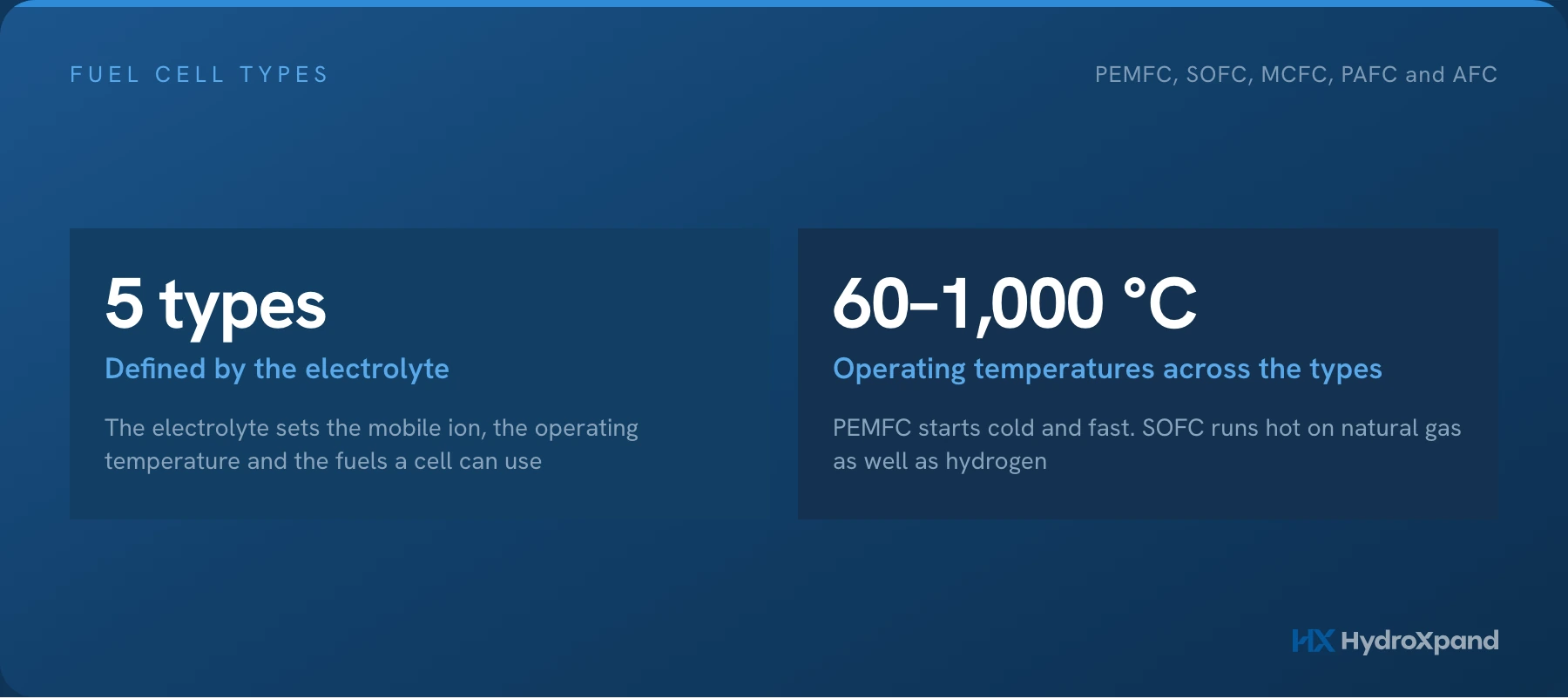
In short: fuel cell types are defined by the electrolyte. The polymer-membrane PEMFC (vehicles and homes), the ceramic SOFC (power plants), the molten carbonate MCFC (large-scale power), the phosphoric acid PAFC (distributed power for buildings) and the alkaline AFC (spacecraft) are the five main types. Change the electrolyte and you change the ion that crosses it, the operating temperature and the fuels the cell can use.
How a hydrogen fuel cell turns hydrogen into electricity is covered in our articles on fuel cell pros and cons and on how a fuel cell works. This article explains why there are several types and where each is used.
- The electrolyte determines the type. Once it is chosen, the mobile ion, operating temperature, catalyst and acceptable fuels follow.
- PEMFC starts quickly at low temperature and can be made compact, so it powers cars, buses and home units. It needs platinum catalysts and high-purity hydrogen.
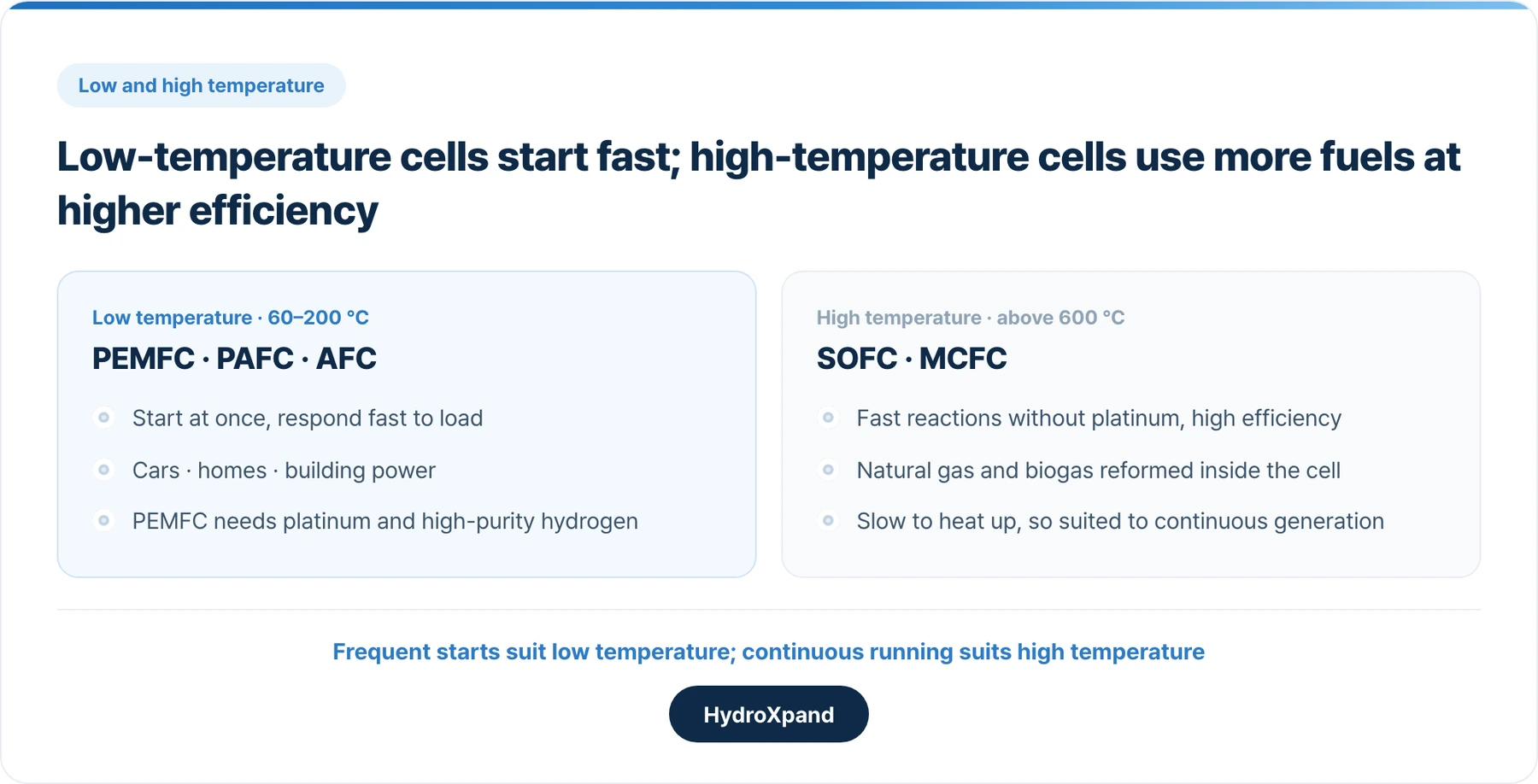
- SOFC and MCFC run above 600 °C, reach high efficiency and can use fuels such as natural gas, so they are used for power generation. They take time to start and stop.
- PAFC, one of the earliest types to be commercialised, provides distributed power for buildings. AFC is used where pure hydrogen and oxygen are available, such as spacecraft.
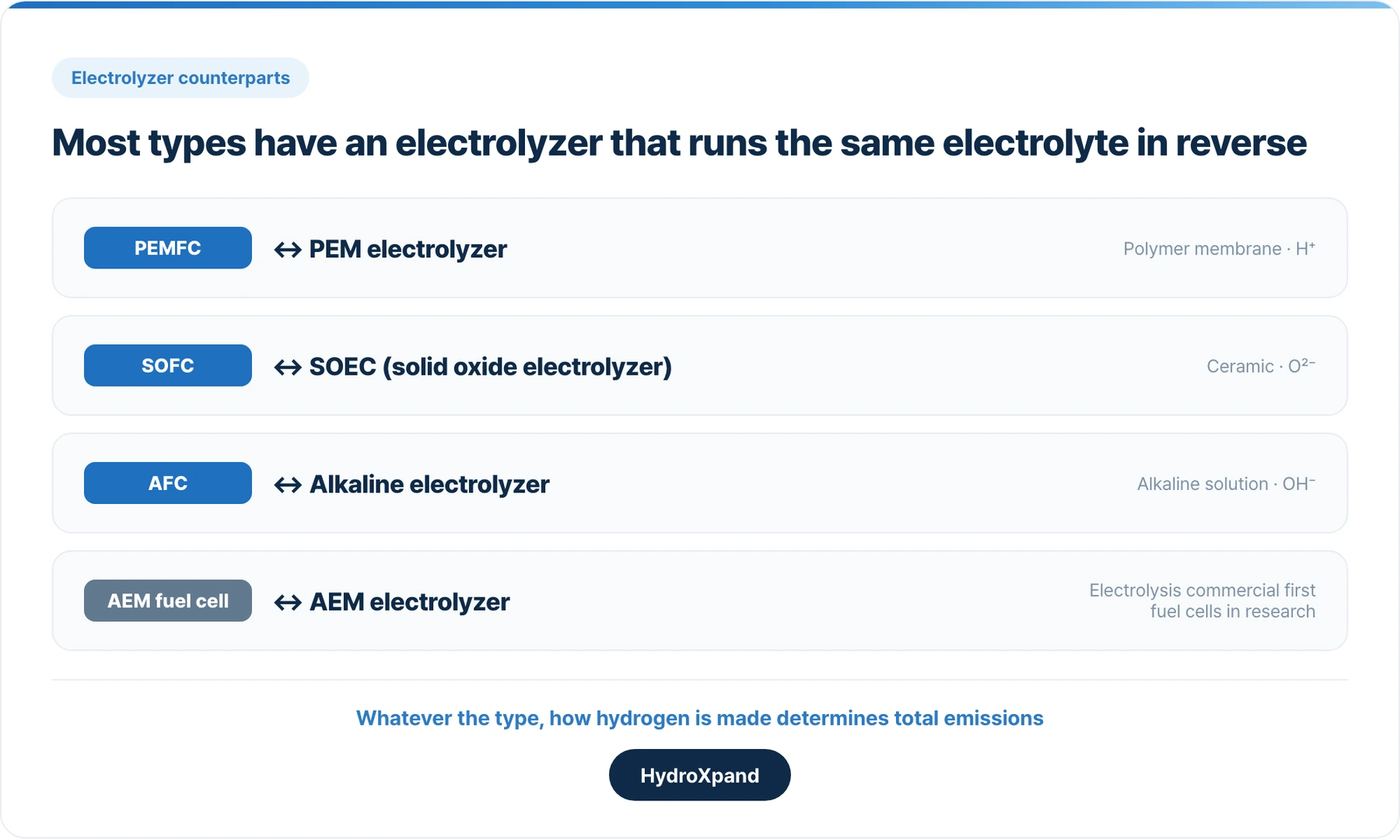
- Electrolyzers use the same names: PEM fuel cells and PEM electrolyzers, SOFCs and SOECs, and alkaline fuel cells and alkaline electrolyzers use the same electrolytes to run the reactions in opposite directions.
The five types at a glance
| Type | Electrolyte (mobile ion) | Operating temperature | Typical use |
|---|---|---|---|
| PEMFC | Polymer membrane (H⁺) | 60–80 °C | Cars, buses, homes |
| SOFC | Ceramic (O²⁻) | 600–1,000 °C | Power plants, buildings |
| MCFC | Molten carbonate (CO₃²⁻) | About 650 °C | Large-scale power |
| PAFC | Phosphoric acid (H⁺) | 150–200 °C | Building CHP |
| AFC | KOH solution (OH⁻) | 60–90 °C | Spacecraft, special uses |
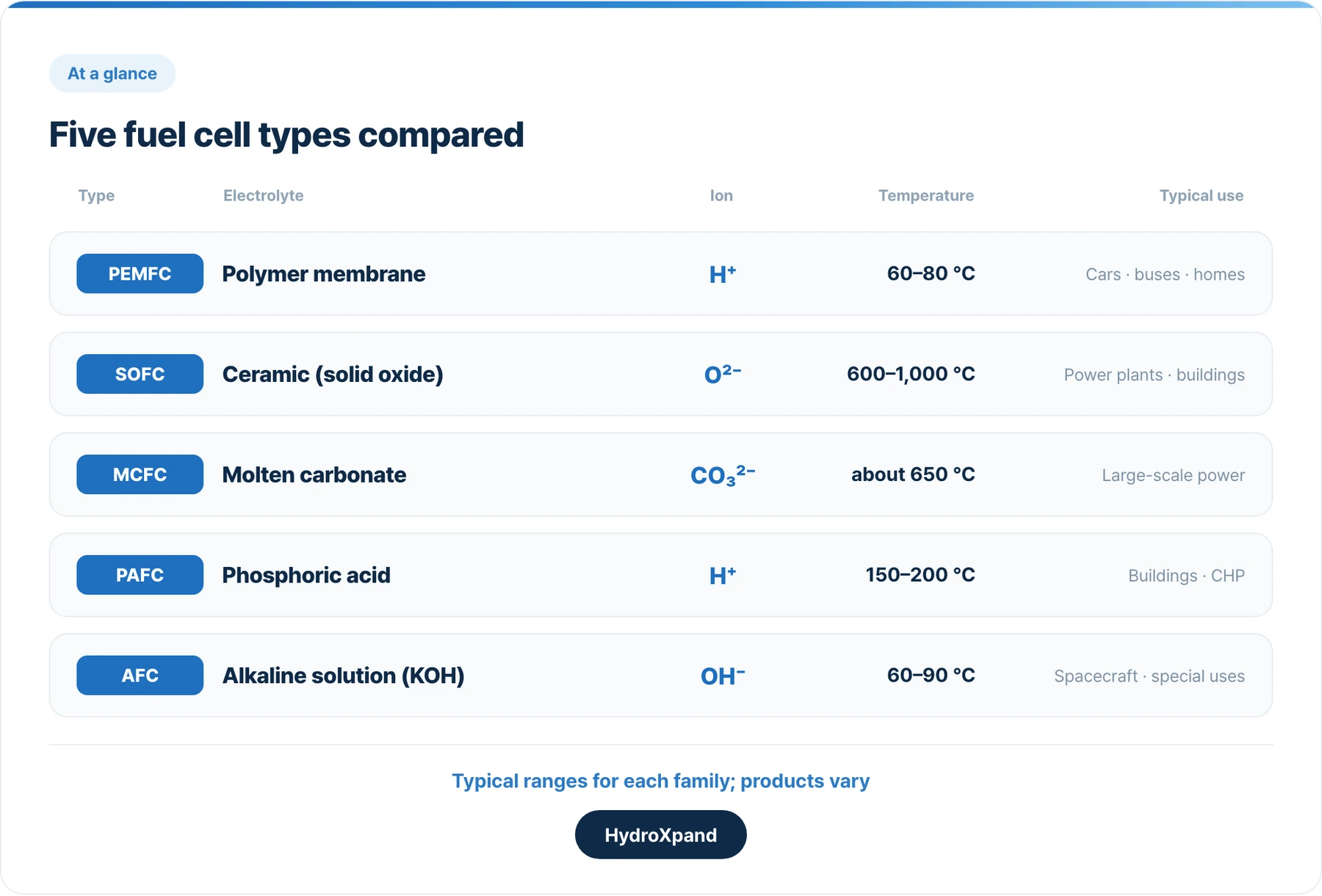
The temperatures and uses shown are typical of each family and vary between products. The choice of electrolyte determines the other characteristics.
Each type in one line:
- PEMFC: starts quickly and can be made compact; needs platinum catalysts and high-purity hydrogen.
- SOFC: high efficiency and a wide choice of fuels; slow to start, and durability at high temperature is the challenge.
- MCFC: suited to high power output and heat recovery; needs CO₂ recirculation to supply carbonate ions.
- PAFC: one of the earliest commercial types; moderate efficiency, well suited to combined heat and power.
- AFC: can use non-precious catalysts; sensitive to CO₂ in air, so it needs pure oxygen and hydrogen.
Efficiency and size
Fuel cell types also differ in electrical efficiency and typical power output. The U.S. Department of Energy's comparison chart gives these typical values.
| Type | Electrical efficiency (LHV) | Typical stack size |
|---|---|---|
| PEMFC | 60% direct H₂ · 40% reformed fuel | Under 1 kW – 100 kW |
| SOFC | 60% | 1 kW – 2 MW |
| MCFC | 50% | 300 kW – 3 MW |
| PAFC | 40% | 5 – 400 kW |
| AFC | 60% | 1 – 100 kW |
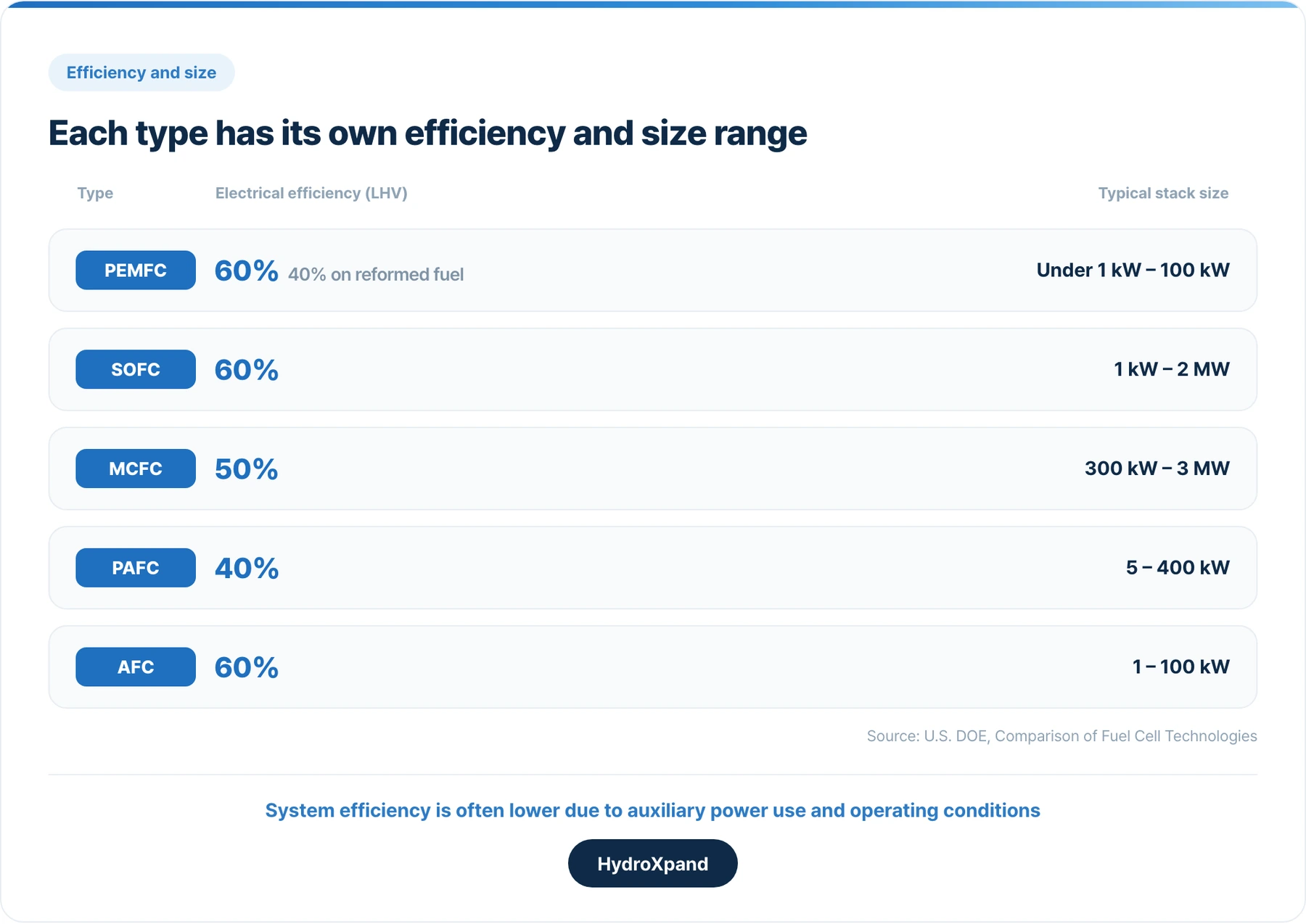
A PEMFC is efficient on pure hydrogen, but on fuel reformed from natural gas losses in the reformer reduce efficiency to about 40%. SOFC and MCFC release heat at high temperatures, making it easy to recover for combined heat and power, and total efficiency rises further when that heat is used. In terms of power output, PEMFC and AFC suit mobile applications and small units of a few kilowatts to 100 kW, while MCFC suits power plants of several hundred kilowatts and above.
These are representative values for each family. Actual system efficiencies are often lower because of the power drawn by auxiliary equipment and the operating conditions, which is why hydrogen fuel cell systems are commonly quoted at 40 to 50% electrical efficiency.
PEMFC: the low-temperature fuel cell in cars and homes
The proton exchange membrane fuel cell uses a thin polymer membrane as its electrolyte. The membrane conducts hydrogen ions (H⁺), and the cell runs at about 60 to 80 °C. It delivers power as soon as it starts and adjusts its output quickly, which suits applications with frequent starts, stops and load changes: cars, buses and forklifts. Many home fuel cell units use this type too.
Its weak points are the catalyst and the fuel. Fast reactions at low temperature require a platinum catalyst, and impurities such as carbon monoxide poison it, so the hydrogen must be very pure. The membrane also has to be kept from drying out or flooding.
SOFC: the high-temperature fuel cell for power plants
The solid oxide fuel cell uses a ceramic electrolyte, which conducts oxygen ions (O²⁻) at about 600 to 1,000 °C. At that temperature the reactions are fast without platinum, and the cell can reform natural gas or biogas internally as well as run on hydrogen. Its electrical efficiency is high, and using its heat raises total efficiency further. It is used for buildings and power plants.
The trade-offs are a long warm-up, which rules out frequent starts and stops, and the difficulty of maintaining the durability of ceramic and metal parts at high temperature.
MCFC: the molten carbonate fuel cell for large-scale power
The molten carbonate fuel cell uses molten carbonate salts as its electrolyte, with carbonate ions (CO₃²⁻) as the mobile ion. It runs at about 650 °C and suits high power output. Forming carbonate ions requires carbon dioxide at the cathode, so the system recirculates CO₂. Like SOFC, its high temperature allows it to use different fuels and makes its heat useful for recovery.
PAFC: one of the first commercial fuel cells
The phosphoric acid fuel cell uses phosphoric acid as its electrolyte, with hydrogen ions as the mobile ion. It runs at about 150 to 200 °C and has long been used for distributed generation and combined heat and power in buildings and districts. Its electrical efficiency is moderate, but it is well suited to heat recovery, and its long commercial history provides extensive operating experience.
AFC: the alkaline fuel cell that flew in space
The alkaline fuel cell uses a potassium hydroxide (KOH) solution as its electrolyte, with hydroxide ions (OH⁻) as the mobile ion. The alkaline environment allows non-platinum catalysts, and it was used to power spacecraft early on. Its weakness is carbon dioxide in air, which reacts with the electrolyte to form carbonate and lowers performance, so it is mainly used where pure oxygen and hydrogen are available.
Choosing by application
Three questions guide the choice of type: how often the unit starts and stops, how much power is needed, and which fuel is available.
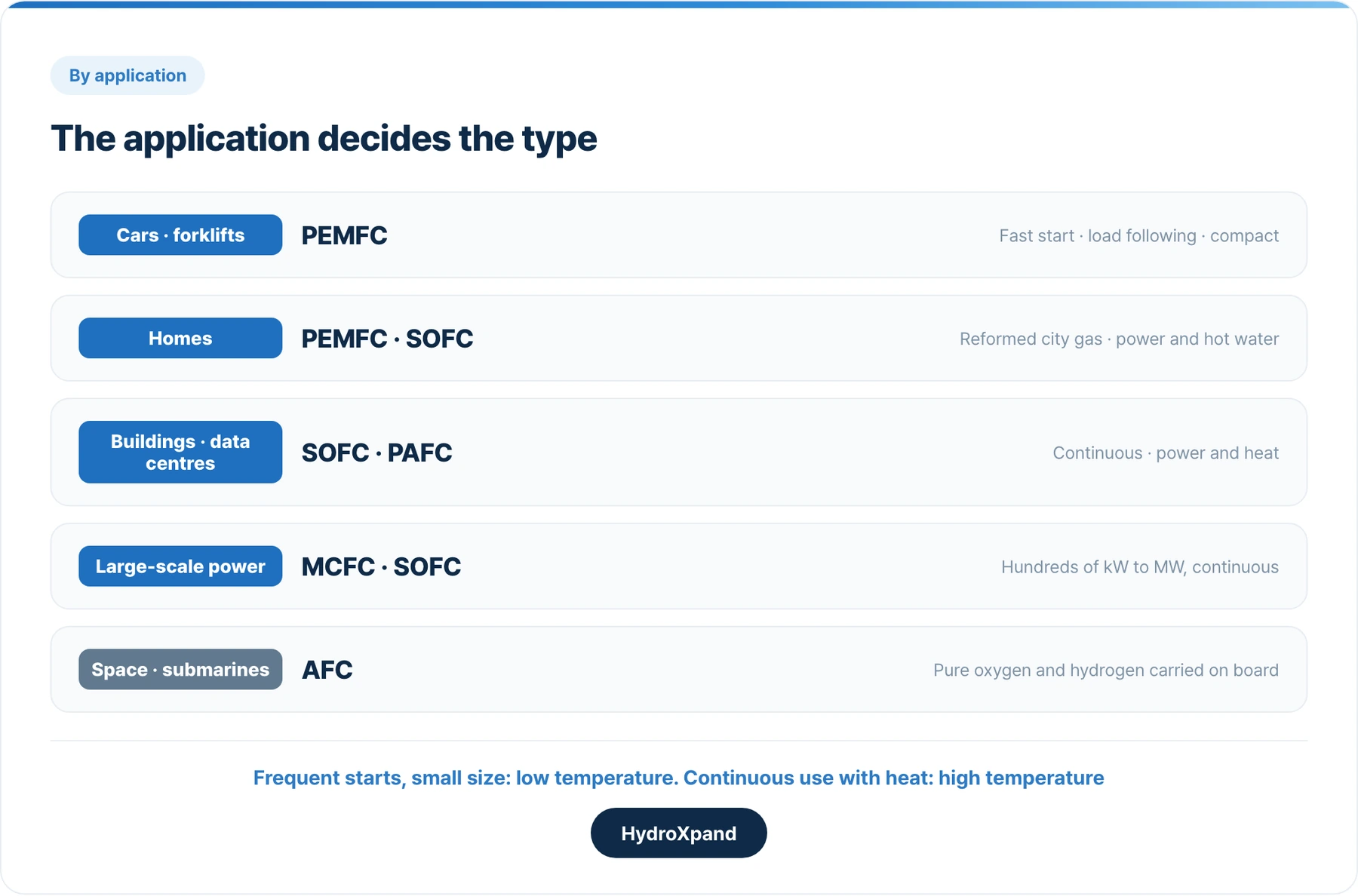
- Cars, buses and forklifts: PEMFC. They need fast start-up, a quick response to load changes and a compact design.
- Homes: both PEMFC and SOFC are used. Japan's home fuel cell programme, Ene-Farm, has deployed both. They reform city gas to supply electricity and hot water together.
- Buildings and data centres: SOFC and PAFC, where the unit runs continuously and both electricity and heat are used.
- Large-scale power: MCFC and SOFC, for plants running continuously at outputs from several hundred kilowatts to megawatts.
- Spacecraft, submarines and other special environments: AFC, where pure oxygen and hydrogen are carried on board.
The choice of fuel makes the distinction clearer. A low-temperature PEMFC is sensitive to carbon monoxide and needs pure hydrogen; to run on city gas, as home units do, it needs a separate reformer and fuel clean-up stage. A high-temperature SOFC or MCFC can reform natural gas or biogas inside the cell, so it can be installed where there is no hydrogen supply chain. With hydrogen pipelines and stations still scarce, that is why high-temperature types came first in power generation.
Frequent starts and a compact design point to a low-temperature type; continuous operation in one place, with the heat put to use, points to a high-temperature type.
Fuel cells and their electrolyzer counterparts
Fuel cells and electrolyzers use the same electrolytes to run the reactions in opposite directions. The PEM fuel cell pairs with the PEM electrolyzer, the SOFC with the SOEC (solid oxide electrolysis cell), and the alkaline fuel cell with the alkaline electrolyzer. AEM, the anion exchange membrane that brings a solid membrane to alkaline chemistry, follows the same pattern: AEM electrolysis has reached commercial use first, while AEM fuel cells are still in research.
Fuel cells in Korea
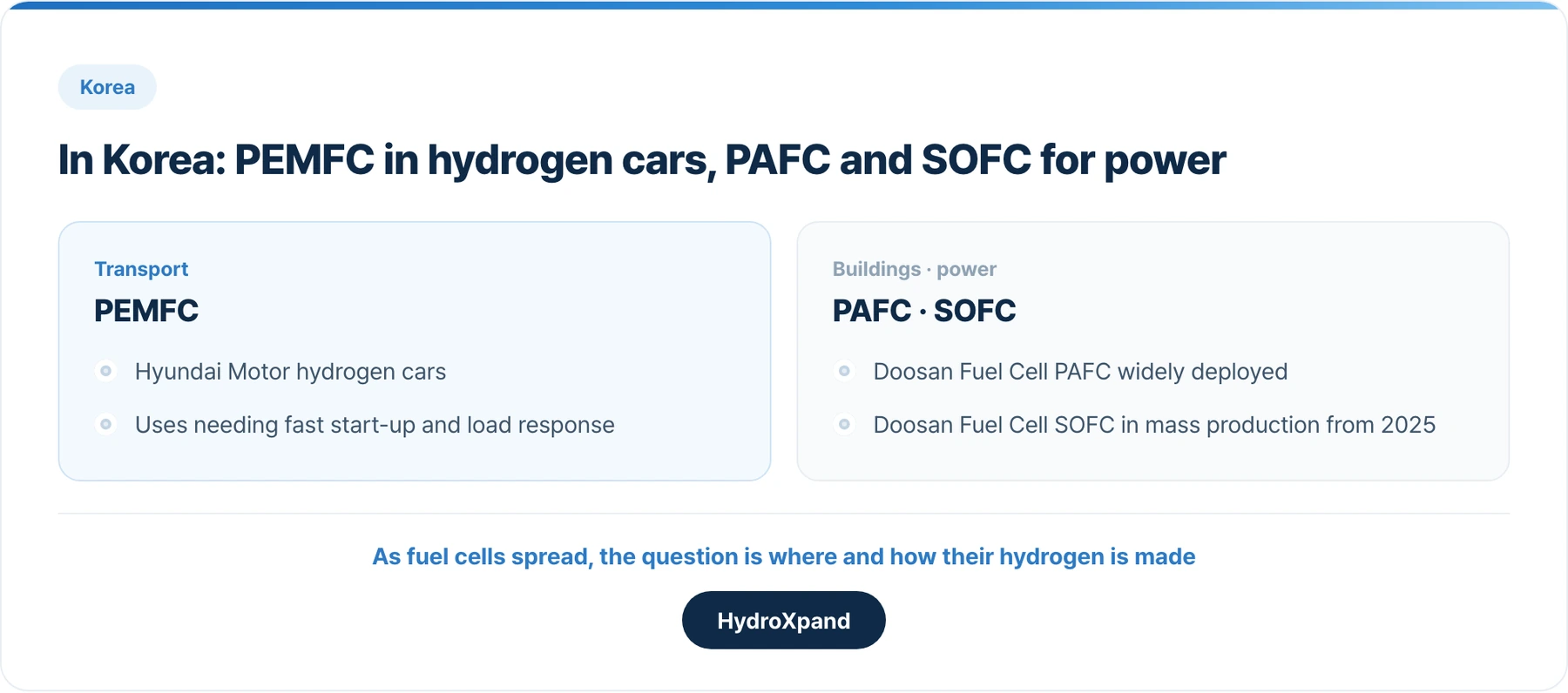
Korea is an active market for fuel cell power. Hyundai Motor uses PEMFCs in its hydrogen cars, and Doosan Fuel Cell's PAFC has been the main type deployed for buildings and power generation. Doosan Fuel Cell also began mass production of SOFCs in 2025. Korean fuel cell and electrolyzer companies are covered in more detail in our fuel cell and electrolyzer comparison.
As fuel cells spread, the next question is where, and how, the hydrogen they use will be made.
Fuel cell types seen from the electrolyzer side
HydroXpand does not make fuel cells. We work on the opposite side, making AEM electrolysis electrodes, stacks and systems that split water with electricity to make hydrogen. Whatever the fuel cell type, the source of its hydrogen determines its total emissions, and the lower the operating temperature, the purer the hydrogen has to be. Hydrogen made by electrolysis is a natural starting point for meeting that requirement.
- How a hydrogen fuel cell works→Four steps, cell voltage, voltage losses and efficiency.
- Hydrogen fuel cell pros and cons→Four strengths of the cell and four limits of the wider system.
- Fuel cell vs electrolyzer: the same parts, run backwards→Including Korean fuel cell and electrolyzer companies.
- Alkaline, PEM or AEM electrolysis→The electrolyzer side of the same electrolyte families.
- What is SOEC electrolysis→The solid oxide electrolyzer that pairs with the SOFC.
Frequently asked questions
What type of fuel cell do hydrogen cars use?
The PEMFC, or proton exchange membrane fuel cell. It starts at low temperature, responds quickly to load changes and can be made compact.
Why do power plants use SOFCs?
They run above 600 °C, reach high efficiency without platinum and can use fuels such as natural gas. They take time to start and stop, so they suit continuous generation.
What determines the type of a fuel cell?
The electrolyte. Once it is chosen, the mobile ion, operating temperature, catalyst and acceptable fuels follow.
Do electrolyzers come in the same types?
Yes. PEM, alkaline, solid oxide (SOEC) and AEM electrolyzers use the same electrolytes as their fuel cell counterparts to run the reactions in the opposite direction.
How does efficiency differ between fuel cell types?
In the DOE comparison chart, PEMFC, SOFC and AFC have electrical efficiencies (LHV) of about 60%, MCFC about 50% and PAFC about 40%. PEMFC on reformed fuel falls to about 40%, and total efficiency rises when the heat is used.
What type of fuel cell is used in homes?
Both PEMFC and SOFC. Home units reform city gas into hydrogen and supply electricity and hot water together.
Sources
- Comparison of Fuel Cell Technologies — U.S. Department of Energy, Fuel Cell Technologies Office, 2016
- Types of Fuel Cells — U.S. Department of Energy
Looking at AEM for a specific application?