Electrolyzer product grades are not closely spaced. Ours step from about 1 kg a day to a 15 kg design, and most enquiries land somewhere in between. Repeating the small unit fills that range, and what it actually changes is operation rather than output.
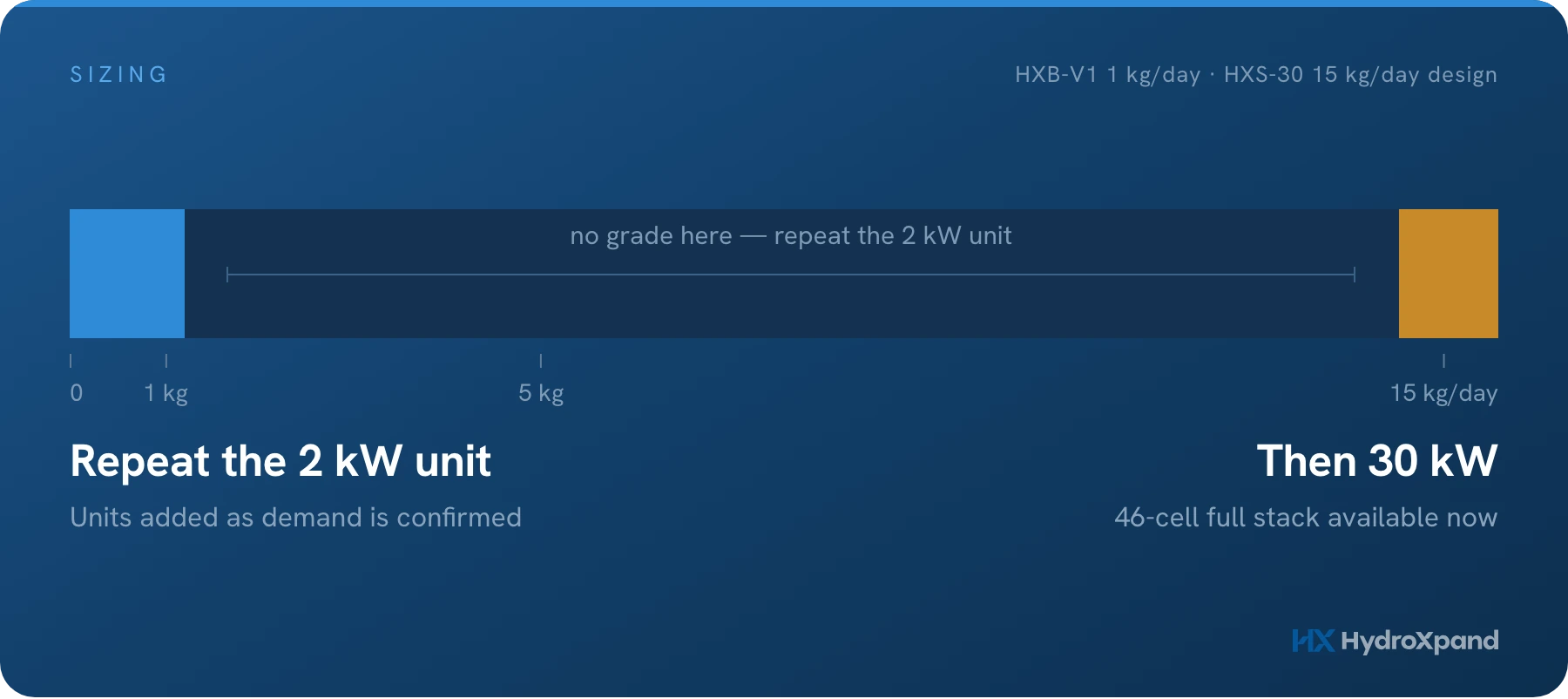
Sizing conversations usually stall at the same place. The quantity of hydrogen the site needs sits above what one unit makes and well below the next grade, and nothing in the catalogue lands on it.
Electrolyzer grades are not closely spaced, and the reason is that a stack is redesigned rather than stretched. Our own steps show it plainly: HXB-V1 produces 480 NL/h, roughly 1 kg a day, and HXS-30 is a 6,900 NL/h design, 15 kg a day. That is a factor of fifteen with nothing between.
Demand of 3, 5 or 10 kg a day sits inside that gap. So does most on-site production for small mobility fuelling, and most continuous low-volume industrial use. The way to fill it is to repeat a unit that already exists rather than wait for one that does not.
What repeating a unit buys
Five units and one larger machine can produce the same quantity. What separates them is not output, it is what happens on the days the plant is not running normally.
A single large machine taken out for service takes production to zero. With five units, removing one leaves four running. That matters to us specifically because stack servicing means the stack comes back to us, so there is a period when that unit is out; in a multi-unit arrangement, supply continues through it.
Capacity can also follow demand rather than anticipate it. The same unit is added later, so the plant starts at the demand that is certain and grows by units. HXB-V1 is a 19-inch rack format, so growing usually means adding to the rack rather than rearranging the room.
And when the available power falls, which happens daily on a renewable-coupled site, the response is to shut units down and match the total with how many are running, rather than to run everything at a low load. Low load is where gas purity headroom is thinnest, so having the option to leave the running units at a load you have measured data for is worth more than it first appears.
Five units and one larger machine make the same hydrogen. They behave differently on the day one of them is out.
What it costs
Two things grow with the unit count, and both are ordinary rather than surprising.
First, connections. Every unit needs water in, hydrogen out, oxygen out, vent and drain, plus its own power feed and its own network cable. HXB-V1 draws about 2.4 kW each, so five units ask the site for that much times five. The network side is light, one cable per unit into a switch, but the cabling still exists per unit.
Second, footprint. Each unit is 482 × 647 × 266 mm and 51.3 kg, and needs 300 mm in front and 400 mm behind. Racking recovers floor area but not height or access. The 5 to 45 °C indoor condition and the site's ventilation arrangements apply to the room regardless of how many units are in it.
There is also a per-unit overhead that is easy to miss on a spreadsheet. Power conversion, the circulation pump and instrumentation sit inside each unit. On HXB-V1 that balance of plant is 0.4 kW of the 2.4 kW total, and it repeats with every unit, where a single larger machine provides it once. Whether that matters depends on the duty cycle, so it belongs in a comparison of total consumption at the design stage rather than in a rule of thumb.
| Parallel small units | One larger machine | |
|---|---|---|
| Production during service | Continues on remaining units | Zero |
| Adding capacity later | Add the same unit | Replace or add a second machine |
| Falling available power | Shut units down, keep the rest at a measured load | Run the single machine at low load |
| Connections | Per unitwater, gas, vent, drain, power, network | Once |
| Balance of plant | 0.4 kW per unitrepeats with every unit | Once |
| Footprint | Grows with unit countrack recovers floor, not access | Single location |
How the arrangement actually looks
We proposed a ten-unit parallel arrangement to an overseas customer, and the shape of it is worth describing because it is less complicated than the unit count suggests.
Hydrogen outlets are collected. Each unit feeds a common header, and drying and storage sit downstream of that header and are sized once for the plant. Those do not repeat per unit.
Water is not collected. Each unit has an internal gear pump that draws from the customer's tank and tops itself up, so there is no external feed pump to specify.
Operation runs from one laptop. Each unit takes a network cable to a switch, and the desktop application's multi-unit screen issues both plant-wide commands and individual control. No unit is a master; each one is a complete generator and the coordination is in software.
Power arrives per unit as single phase, 200 to 240 V, about 2.4 kW each.
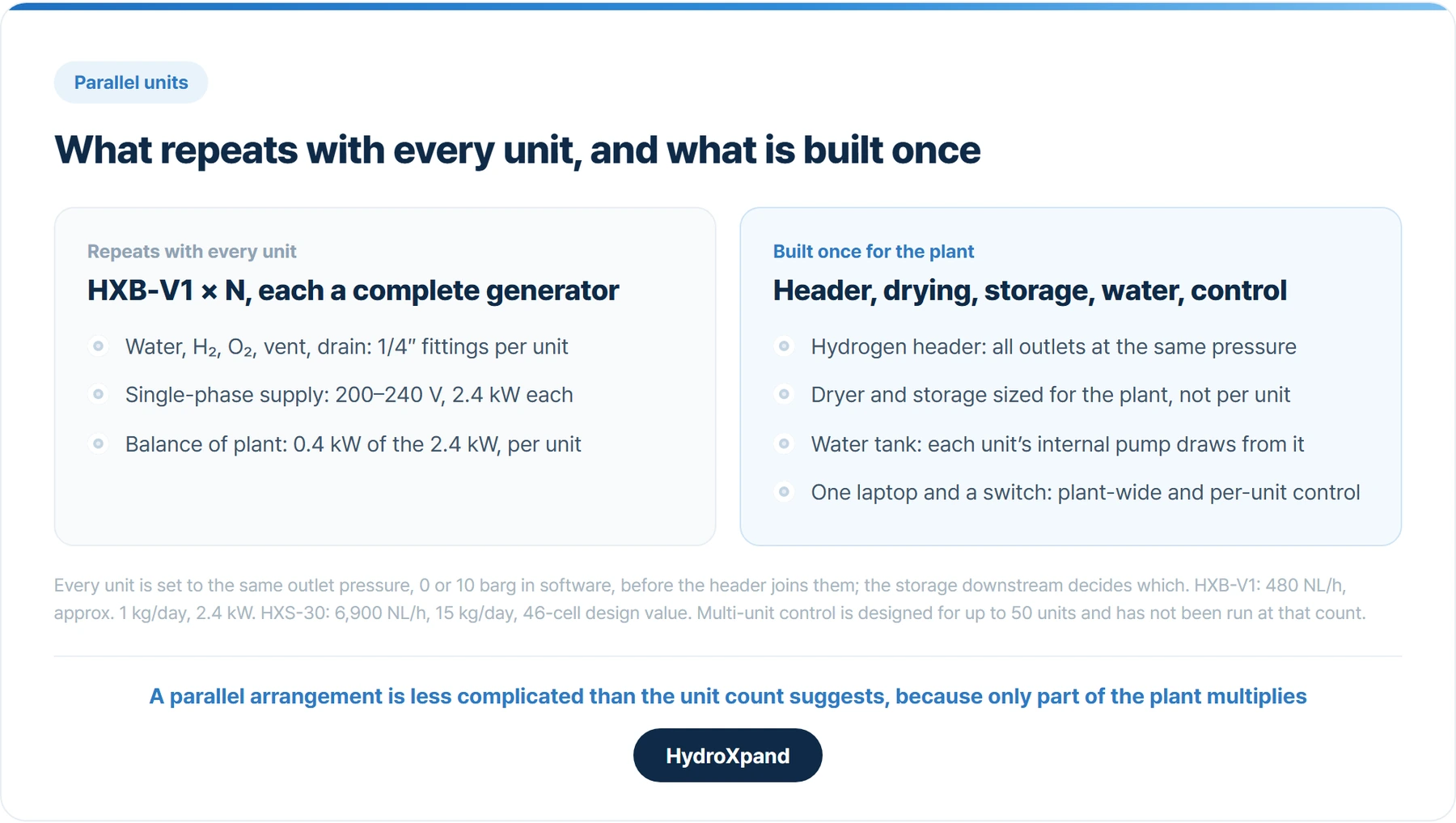
What is left as genuine design work is the header: its diameter, and pressure balance between units. HXB-V1 selects 0 or 10 barg in software per unit, so every unit is set to the same pressure before the header joins them, and the storage downstream is what decides which.
Where the parallel approach stops
Repeating a unit has a limit, and there are three separate ways to reach it.
By quantity: above roughly 15 kg a day you are looking at more than fifteen 2 kW units, and a design built on HXS-30 becomes easier on both piping and floor area. The 46-cell full stack is available now, under long-term evaluation after its first operation. A 30 kW system as a finished product is roadmap, not a current specification.
By site requirement: some projects need a single skid, or have a fixed footprint that a growing unit count does not fit. That points at the larger stack regardless of quantity.
By software: the multi-unit control is designed for up to 50 units. We have not run that many simultaneously, so treat it as a design limit rather than a demonstrated one, and anything in the tens of units deserves its own conversation about operating evidence.
Between about 1 and 15 kg a day, repeat the 2 kW unit. Above that, the unit to repeat becomes the 30 kW stack.
Four things to settle before choosing a size
- Daily quantity and operating hours. Hourly output multiplied by hours gives the daily figure, so how many hours a day the plant can run is what sets the unit count. On a renewable-coupled site, the generation profile replaces this number.
- Whether production can stop. If supply cannot be interrupted, size one unit above the requirement. If it can, size to the requirement.
- Expansion. If demand may grow, reserve the rack space, the header capacity and the electrical headroom now, even if the units come later.
- Site and power. Floor area, clearances, ventilation, and whether the building's circuits carry 2.4 kW per unit at the final count.
Those four are worth settling whoever you buy from. Tell us the required flow and the daily operating hours and we will propose a unit count and an operating range together, which is a more useful starting point than a quotation against a capacity figure alone.
- What is an electrolyzer stack→What a stack is made of, how cell count scales output, and what decides performance.
- Before the electrolyzer arrives→The site checks behind the footprint, power and water figures above.
- Running an electrolyzer on solar→How far down a unit can be turned, and why shutting units off is the other answer.
- Pressurised operation, measured→The crossover data behind "low load is where the headroom is thinnest".
- HXB-V1 · 2 kW system→The repeated unit: 480 NL/h, 2.4 kW, 6U rack format.
- HXS-30 · 30 kW stack→The next unit up, and what is available now versus in development.
- What turnkey includes in a 2 kW electrolyzer→What one unit contains, before you multiply it.
- Do you need a compressor?→Why every unit on a header has to be set to the same pressure.
- Putting an electrolyzer inside your own plant→What you can set, read and connect from your own controller.
Frequently asked questions
Should I buy several small electrolyzers or one larger stack?
Between about 1 and 15 kg per day, repeating the 2 kW unit fills the range. Above that, the unit to repeat becomes the 30 kW stack.
What does running units in parallel change?
Operation rather than output. Five units and one larger machine make the same hydrogen, but they behave differently on the day one of them is out, and they handle a falling load differently.
How far apart are the HydroXpand product grades?
The HXB-V1 makes about 1 kg per day at 480 NL/h and the HXS-30 is designed for 15 kg per day at 6,900 NL/h, a 15-fold gap.
Looking at AEM for a specific application?