Turn an electrolyzer down and slightly less hydrogen crosses the membrane, yet hydrogen in oxygen goes up. Worked through with 49 points measured on a 2 kW stack, including what pressure adds and what to allow for when setting a minimum load.
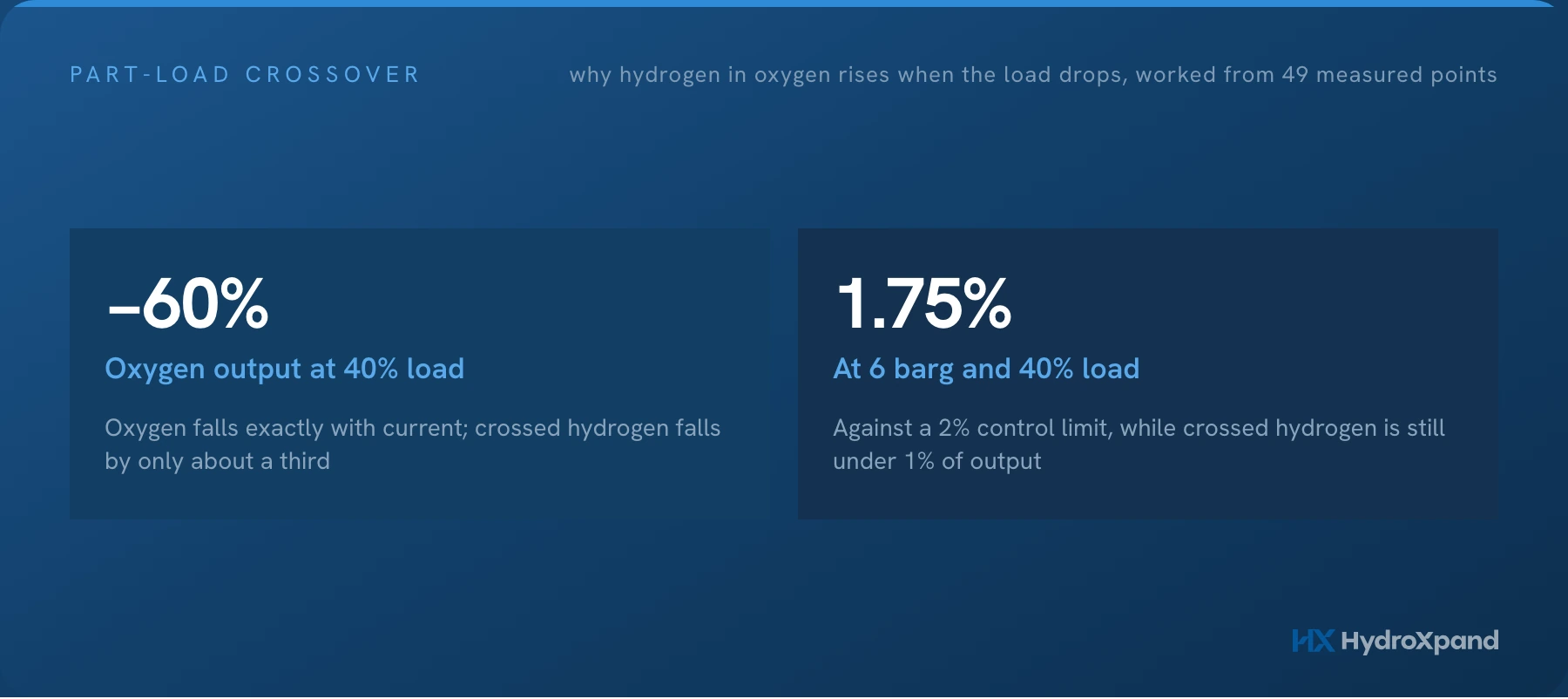
When an electrolyzer runs on a supply that rises and falls, such as solar or wind, it spends time at reduced load. At reduced load the concentration of hydrogen in the oxygen stream goes up. That concentration has a safety limit, and it decides how far the load can be turned down.
When the load drops, the amount of hydrogen crossing the membrane actually falls a little. We worked out why the concentration rises anyway, using measurements on our 2 kW, 23-cell stack: seven pressures, seven loads at each, 49 points, in 0.1 M KOH.
- Hydrogen in oxygen generally rises as load drops. Oxygen falls with load, while the hydrogen crossing the membrane falls much less.
- Raising pressure makes the rise larger, because more hydrogen crosses at higher pressure.
- Judge by the safety limit, not the efficiency loss. Crossed hydrogen is under 1% of production, but the concentration approaches the limit.
- When you set minimum load, allow for concentrations above those measured on a new stack. With operating time the concentration can rise under the same conditions.
Why hydrogen in oxygen matters
In AEM electrolysis hydrogen forms at the cathode and oxygen at the anode, with a membrane between them. Even with the membrane in place, some cathode hydrogen passes through to the anode side and leaves mixed into the oxygen. This is crossover, and it is usually tracked as hydrogen in oxygen (H₂ in O₂).
At room temperature and atmospheric pressure, hydrogen in oxygen becomes flammable from about 4 vol%. We use half of that, 2%, as our control limit.
Why the concentration rises at lower load
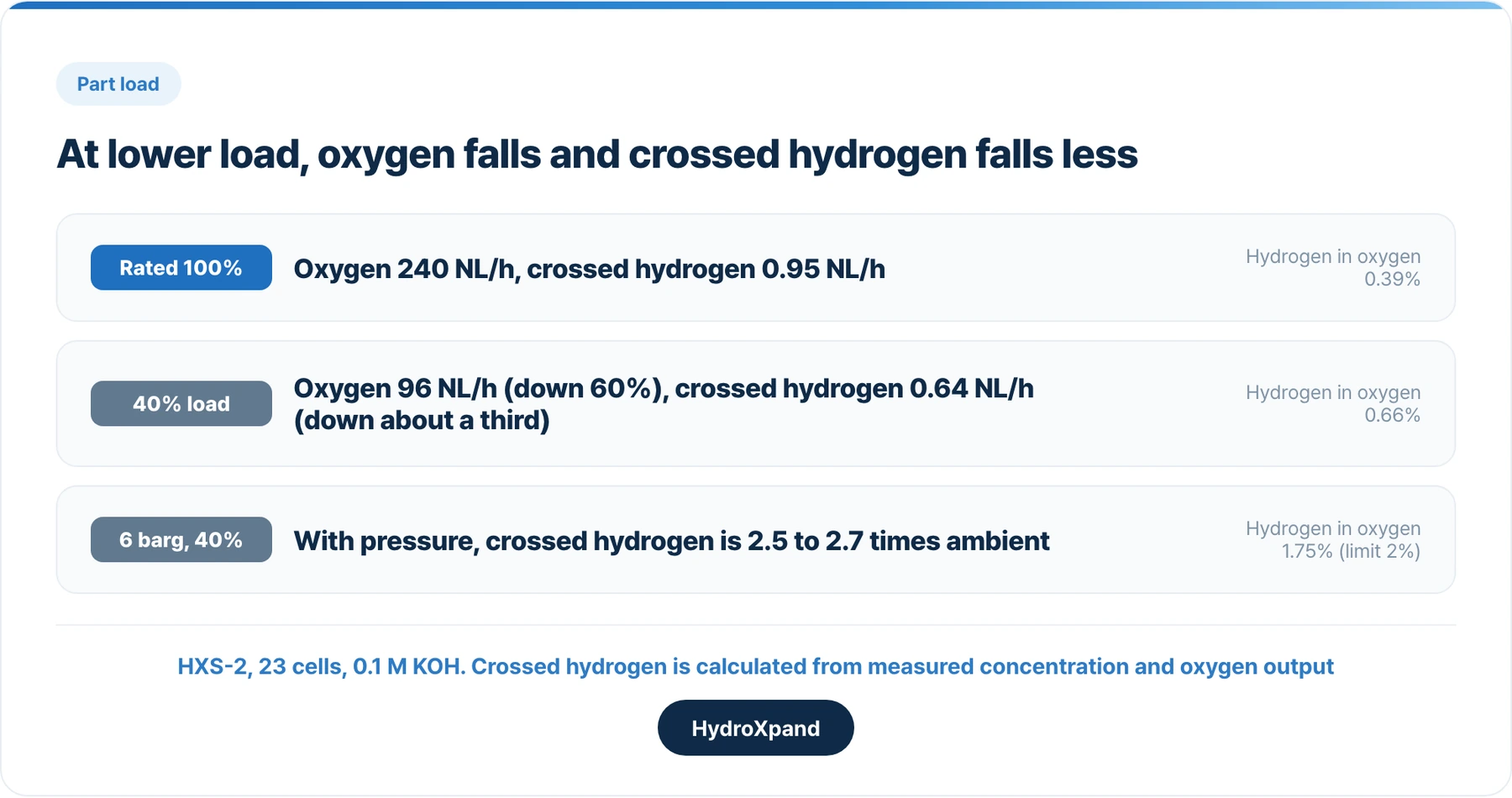
How much oxygen is made is set by current (Faraday's law). A 23-cell stack at 50 A makes about 240 NL/h of oxygen and about 480 NL/h of hydrogen (0 °C, 1 atm). At 40% load, 20 A, oxygen falls to 40%, about 96 NL/h.
From the measured concentration and the oxygen output you can work back to how much hydrogen crossed over. At ambient pressure:
| Load (current) | Oxygen output | Hydrogen in oxygen | Crossed hydrogen (calculated) |
|---|---|---|---|
| 100% (50 A) | 240 NL/h | 0.39% | 0.95 NL/h |
| 80% (40 A) | 192 NL/h | 0.40% | 0.77 NL/h |
| 60% (30 A) | 144 NL/h | 0.49% | 0.71 NL/h |
| 40% (20 A) | 96 NL/h | 0.66% | 0.64 NL/h |
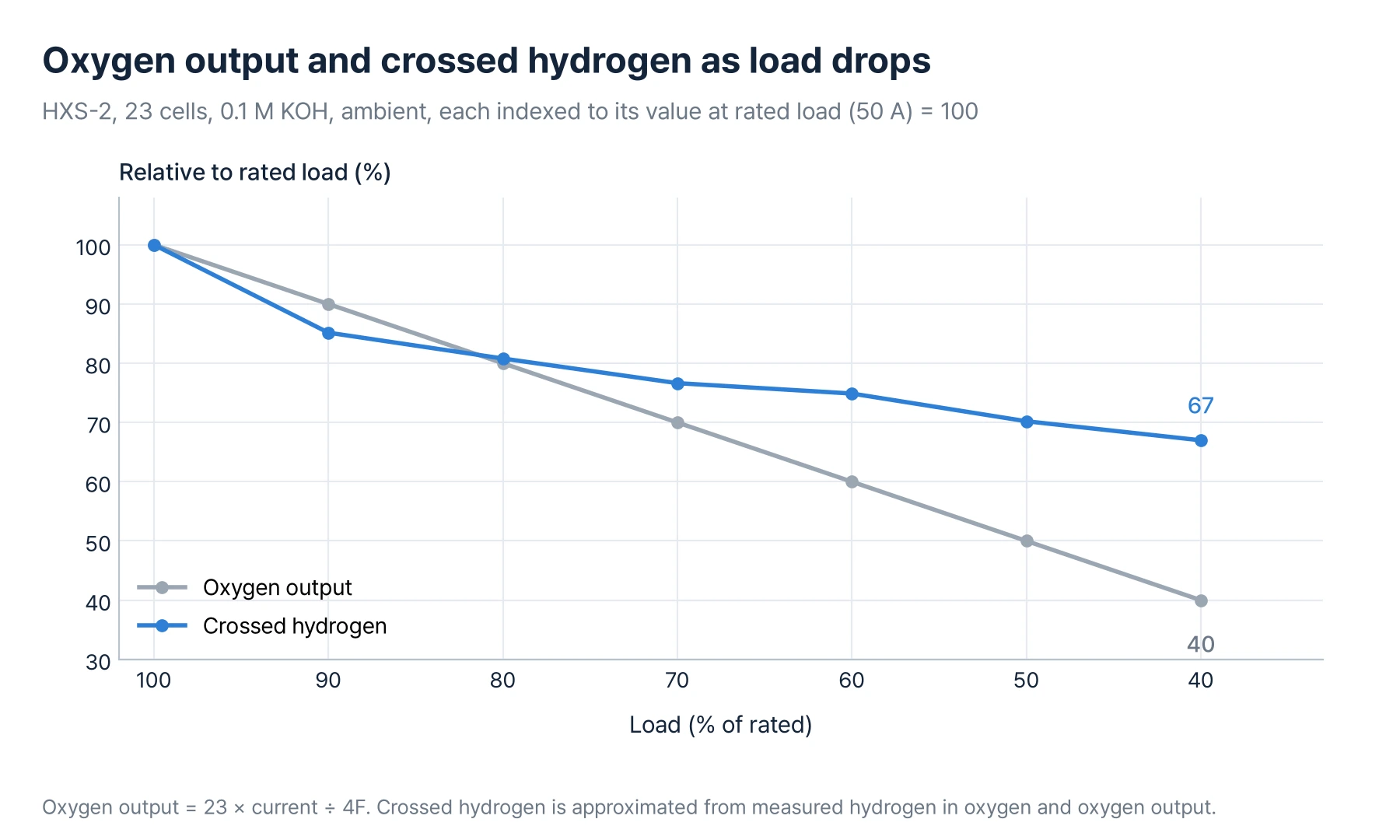
Going from 100% to 40% load, oxygen fell by 60% while crossed hydrogen fell by only about a third. The concentration is crossed hydrogen divided by the total gas, which is almost all oxygen, so as oxygen fell further the concentration went up.
Crossed hydrogen falls less because, as we read it, much of it is set by hydrogen-side pressure rather than current. Turning the current down leaves that part almost unchanged.
Raising the pressure
Raising hydrogen-side pressure increases the hydrogen crossing at every load. The concentration is higher at the same load, and it rises more as load drops.
| Load (current) | 0 barg | 2 barg | 4 barg | 6 barg |
|---|---|---|---|---|
| 100% (50 A) | 0.39% | 0.43% | 0.66% | 0.98% |
| 80% (40 A) | 0.40% | 0.48% | 0.76% | 1.09% |
| 60% (30 A) | 0.49% | 0.60% | 0.95% | 1.33% |
| 40% (20 A) | 0.66% | 0.81% | 1.28% | 1.75% |
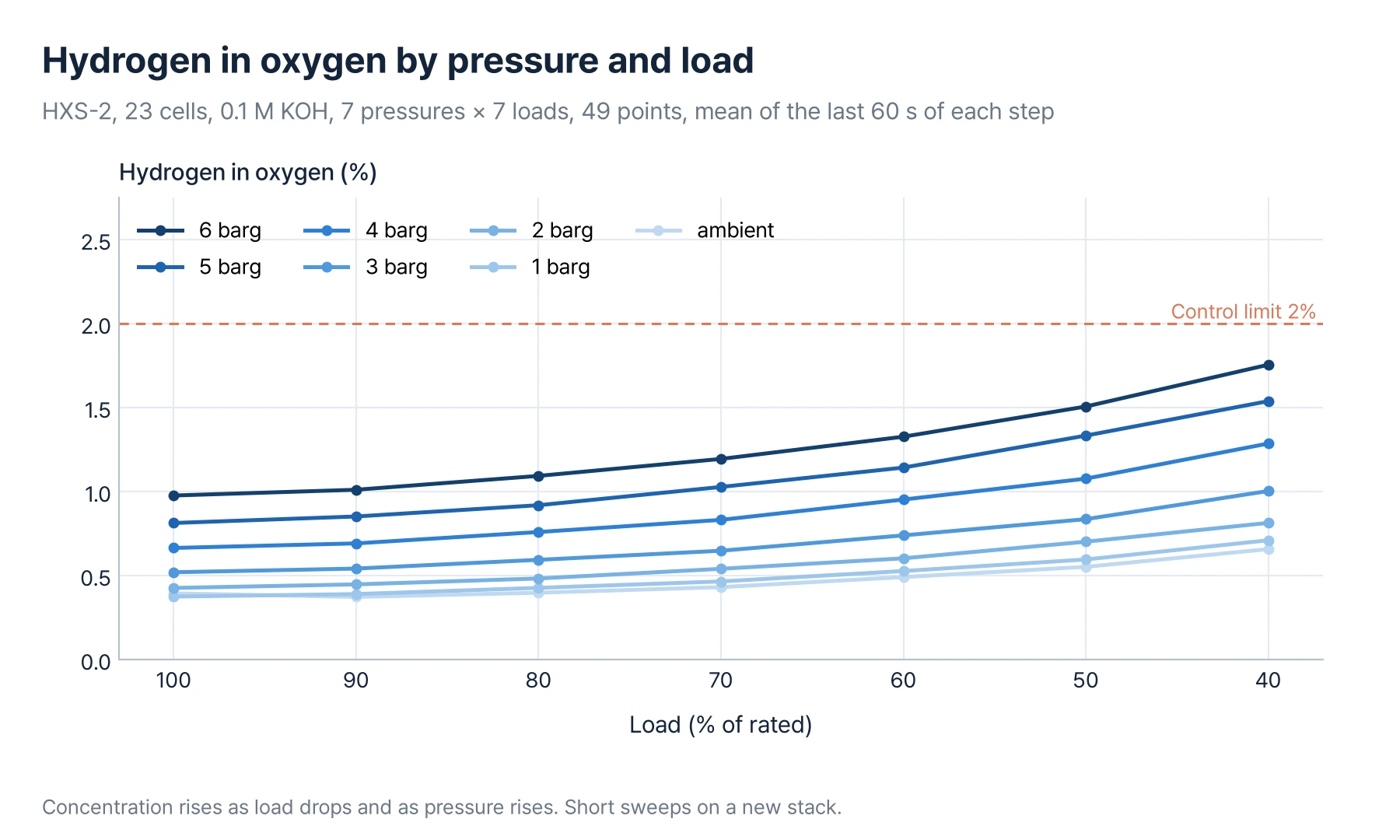
Going from rated to 40% load raised the concentration by about 0.26 percentage points at ambient and about 0.78 points at 6 barg. At 6 barg and 40% load, 1.75% leaves only 0.25 points to the 2% limit, which is why we set minimum load more conservatively under pressure.
- Running an electrolyzer stack at 10 barg→The same data read along the pressure axis.
How much hydrogen output is lost
Crossed hydrogen is not recovered, so it reduces output. Under our test conditions it was 0.2 to 0.9% of production: least at ambient and rated load, most at 6 barg and 40% load.
On efficiency alone, turning the load down costs almost nothing. Between those same two conditions, though, hydrogen in oxygen goes from 0.39% to 1.75%, 4.5 times, and gets close to the control limit. So the floor for part-load operation is set by the safety limit.
Setting minimum load from these figures
These figures come from short sweeps on a new stack. In real operation the concentration can be higher under the same conditions, so we leave a margin when setting minimum load. There are three reasons.
First, it can rise with operating time. On our 10 barg long-term run, hydrogen in oxygen at 50 A went from 1.00% to 1.38% as of 24 October 2026.
Second, it can rise briefly around stops and restarts. This happened in our 3,000-hour cumulative record too. If your operation stops and starts often, look at those periods as well.
Third, it differs from stack to stack. These are measurements on one stack, so keep recording the concentration on the stack you run.
- More than 3,000 hours on an electrolyzer stack→Hydrogen in oxygen over a long ambient run.
What to check before running at part load
| Item | Reason |
|---|---|
| Hydrogen in oxygen by load | A single rated-load figure says nothing about part load |
| The same measurement at your operating pressure | The higher the pressure, the more the concentration rises as load drops |
| Control limit and shutdown condition | Set minimum load from the alarm and shutdown thresholds together with the by-load measurements |
| Change in concentration over a long run | It can climb above new-stack figures, so a margin is needed |
| Gas analyser position and logging interval | You can only run near the floor if you can see the concentration continuously |
- Running an electrolyzer on solar→How far the load can drop on a solar supply.
- Logging electrolyzer operating data→What to record, how often, and how to keep it.
- Technology→How our AEM stacks are built and tested.
Frequently asked questions
Doesn't crossed hydrogen fall when the load drops?
It does, but less than oxygen. In our ambient measurements, going from 100% to 40% load cut oxygen by 60% and crossed hydrogen by about a third, so the concentration rose.
Why doesn't crossed hydrogen fall as much as oxygen?
As we read it, much of it is set by hydrogen-side pressure rather than current. Part of it does grow with current, as more hydrogen is dissolved near the electrode at higher current; turning the load down reduces only that part.
Why is the control limit 2%?
At room temperature and atmospheric pressure, hydrogen in oxygen becomes flammable from about 4 vol%. We use half of that, 2%, as the control limit and recommend stopping for inspection if it is exceeded.
At ambient, isn't 40% load fine?
On a new stack at ambient, 40% load measured 0.66%, well below the limit. The concentration rises with operating time and can rise briefly around stops and restarts, so we do not set the floor from new-stack figures alone.
Does the concentration change as soon as the load changes?
It takes time to settle at the new value: the gas has to travel to the analyser, and the analyser has its own response time. We take the mean of the last 60 seconds of each load step as the value for that load.
Looking at AEM for a specific application?