PEM electrolyzers do things a liquid alkaline plant cannot: hold a large pressure difference, follow a variable power input, and deliver hydrogen that is already pure. All of it follows from one decision, a solid acidic membrane, and so does the bill that comes with it.
Proton exchange membrane electrolysis replaced the liquid electrolyte with a solid one. The membrane is a fluorinated polymer that conducts protons, the water fed to the cell is deionised water rather than an alkali, and the electrodes are pressed directly onto the two faces of the membrane.
That construction is why PEM is the technology most widely deployed for projects with variable power and demanding outlet requirements. It is worth being clear about what it does well before discussing what it costs, because the trade is real in both directions.
What the solid acidic membrane buys
- A dense separator. No open pores means dissolved gas crosses far less readily than through a diaphragm, so hydrogen leaves the cell already pure and the machine can be turned down further before the mixture becomes the limiting factor.
- Differential pressure. The membrane is a mechanical barrier as well as an ionic one, so the hydrogen side can be run at high pressure while the oxygen side stays near ambient. That removes a stage of compression from the plant.
- Dynamics. There is no large inventory of hot circulating alkali to bring to condition, so the cell follows a changing power input closely, which is exactly the behaviour a renewable-powered project needs.
- Current density. PEM cells run hard, which means more hydrogen from a smaller stack and a smaller footprint for the same output.
None of that is marketing. Those four properties are the reason PEM exists and the reason it is the incumbent answer for pressurised, dynamic, high-purity hydrogen. The question a buyer has to answer is what the same decision costs on the other side of the ledger.
Acid decides the materials list
The membrane that conducts protons is strongly acidic in operation. Every component that touches the cell has to survive that environment while an oxidising potential is applied to it, and that requirement, rather than any preference, is what fixes the bill of materials.
a requirement imposed by the need for a high electrochemical stability in the corrosive acidic medium where they have to operate
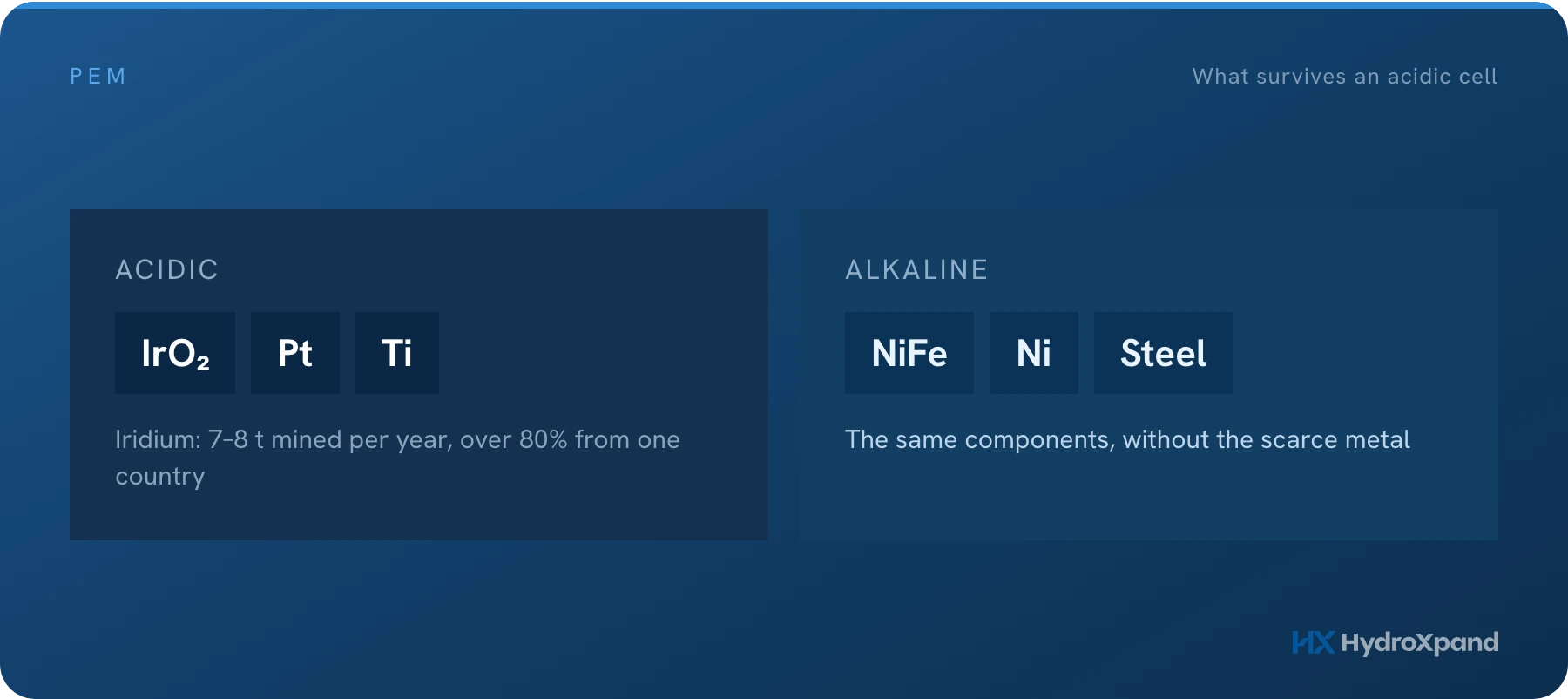
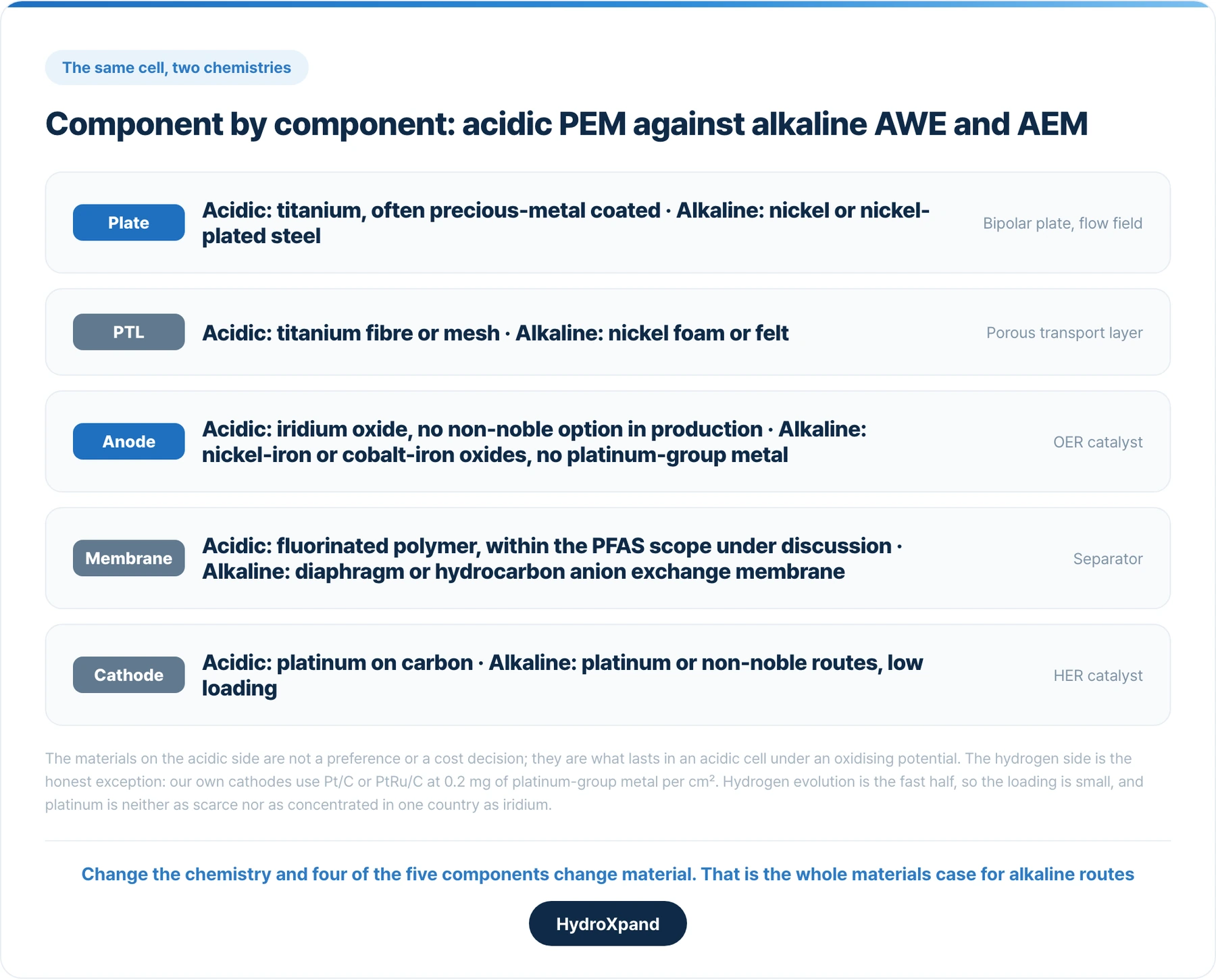
On the oxygen side, almost nothing but iridium oxide survives acidic oxygen evolution at industrial current densities, and there is no non-noble option in production. On the hydrogen side, platinum is the standard catalyst. The porous transport layer and the flow field on the anode are titanium, often with a precious metal coating, because stainless steel and nickel do not last in that environment.
In an alkaline cell the same four components can be nickel, iron and steel. The difference between the two columns is not a difference in ambition. It is the difference between two chemical environments, and it is why catalyst research aimed at leaving the noble metal market is run in alkaline cells.
SourcesMolecules 26(21):6326 (2021): why PEM electrolysis needs noble-metal catalysts · U.S. DOE Technical Targets for PEM Electrolysis: iridium in the anode, platinum in the cathode
The bill of materials, component by component
| Acidic (PEM) | Alkaline (AWE, AEM) | |
|---|---|---|
| Bipolar plate, flow field | Titaniumoften precious-metal coated | Nickel or nickel-plated steel |
| Porous transport layer | Titanium fibre or mesh | Nickel foam or felt |
| Anode catalyst (OER) | Iridium oxideno non-noble option in production | Nickel-iron, cobalt-iron oxidesno platinum-group metal |
| Separator | Fluorinated polymerwithin the PFAS scope under discussion | Diaphragm or anion exchange membranehydrocarbon backbone |
| Cathode catalyst (HER) | Platinum on carbon | Platinum at low loadingnon-noble routes in development |
Read down the acidic column and the reason PEM costs what it costs is visible without a price list. Two of the five rows are set by a metal produced in single-digit tonnes per year, and a third is a polymer class under regulatory review.
Two exposures that sit outside a project's control
Both are public, both are ongoing, and both belong in a risk register rather than in a footnote, because neither can be engineered away by the buyer or the supplier.
Current production of iridium and platinum for PEM electrolysers will only support an estimated 3 GW-7.5 GW annual manufacturing capacity, compared to an estimated annual manufacturing requirement of around 100 GW by 2030.
The iridium figure is small in absolute terms and it is not a reserve problem. It is a rate problem: annual production is what a scale-up has to draw on, and electrolysis is not the only claimant. Thrifting the loading down is an active field with real published results, and the recurring difficulty is that lowering loading and holding durability pull against each other.
The PFAS proposal is a regulatory process, not a ban, and its scope is still being decided. What it means for a buyer today is narrow and concrete: on a fifteen or twenty year horizon, an open regulatory question about a core material is a line item that has to be carried.
SourcesInternational Platinum Group Metals Association, White Paper on Iridium (2022): over 80% of mine supply from South Africa · Johnson Matthey PGM Market Report (May 2026): iridium primary supply around 7 t a year · Hydrogen Europe, Position Paper on PFAS (2023): fluorinated ionomer membranes within the scope of the restriction proposal (industry association)
- HXP-an · anode→Nickel-iron grown on nickel foam, no platinum-group metal.
- HXP-ca · cathode→Low-PGM cathode. We do use platinum on the hydrogen side.
- Datasheets→Six products. No form.
Where we would say PEM is the right answer
We build AEM stacks, and AEM exists to keep the dense membrane while moving the chemistry back to alkaline conditions. That is a real argument, but it is not an argument that PEM should not be bought.
- A multi-megawatt project needing a fifteen-year operating record behind the specific model. AEM suppliers cannot offer that today, ourselves included.
- Very high delivery pressure directly from the stack, beyond what an AEM cell holds today.
- A project whose financing or offtake requires a technology with a long list of comparable references at that scale.
The honest version of the AEM case is not that it uses no precious metal. It is that it does not depend on the one metal whose annual production is measured in single-digit tonnes.
And one correction that belongs in any page written by an AEM supplier about iridium. Our anodes contain no platinum-group metal, but our cathodes do: Pt/C or PtRu/C at 0.2 mg of platinum-group metal per cm² on carbon paper. Hydrogen evolution is the fast half of the reaction so the loading is small, and platinum is neither as scarce nor as geographically concentrated as iridium. Removing it entirely is a research direction, not a claim about a product we ship.
- AEM electrolysis: technology and measured data→How AEM electrolysis works, AEM vs PEM vs alkaline, and the measured data behind our stacks.
- What is an ionomer→The polymer that binds the catalyst layer and carries ions to it, and how AEM and PEM ionomers differ.
- AEM water electrolysis explained→The same dense membrane, in alkaline conditions.
- What a catalyst does→Why the electrolyte, not the preference, decides the catalyst.
- Alkaline water electrolysis→The technology PEM was developed to improve on, and what it is still best at.
- The anode that looks best on day one is not the one that lasts→Our 6,358-hour run on an iridium-free grown anode, and the full published durability distribution.
Frequently asked questions
What is PEM water electrolysis?
PEM electrolysis splits water across a solid acidic proton exchange membrane. The membrane lets the cell hold a pressure difference, follow a variable power input and deliver hydrogen that is already pure.
Why does PEM electrolysis depend on iridium?
The acidic environment rules out most oxygen-side catalysts, leaving iridium. Global iridium production is about 7 to 8 tonnes a year, over 80% of it from a single country.
What is the PFAS issue for PEM membranes?
Fluorinated membranes such as Nafion fall within the scope of the 2023 ECHA restriction proposal on PFAS. A European Commission decision is expected around 2027.
Sources
- Recent Advances in Alkaline Exchange Membrane Water Electrolysis and Electrode Manufacturing (DOI 10.3390/molecules26216326) — Molecules, 2021
- Technical Targets for Proton Exchange Membrane Electrolysis — U.S. Department of Energy
- Green Hydrogen Cost Reduction — International Renewable Energy Agency, 2020
- White Paper on Iridium — International Platinum Group Metals Association, 2022
- PGM Market Report, May 2026 — Johnson Matthey
- Position Paper on PFAS — Hydrogen Europe, 2023
Looking at AEM for a specific application?