Our last note ended at the first run of the 15-cell short stack for the 30 kW HXS-30. We then ran it for 293 hours at 360 A. No cell dropped out, the electrolyte held at 50.0 °C, hydrogen in oxygen stayed below half our recommended limit, and all four stops and restarts returned to the existing trend. What remains open is the rate of voltage rise.
Our last technical note ended on the day we first ran the 15-cell short stack for the 30 kW HXS-30. That was 26 August 2026: 1.660 V per cell at 360 A, and 40 mV between the best and worst of the fifteen cells. A first-day number.
A first-day number tells you little about a stack. It says the thing is assembled and current flows. So we kept it running. This note covers the 293 hours that followed.
The result first. The stack was never taken apart and no cell dropped out. This is the longest continuous run we have done at 30 kW scale. The rate of voltage rise is not yet where we want it, and that number is here too.
A first day tells you nothing about a stack. Time does.
1. What was run, and how
A 15-cell short stack. 512 cm² per cell on the cathode side, injection-moulded cell frame V1, A50R membrane, NiFe porous flow collector. Electrolyte outlet held at 50 °C, constant current at 360 A — 0.70 A/cm².
On the calendar that is fourteen days, 26 August to 9 September. Within it there were four stops and restarts for inspection and one trip. The stack was never taken apart. The horizontal axis below is not calendar time but **cumulative time with 360 A actually flowing**, and that comes to 293 hours.
We exclude the idle time because degradation is divided by time. Counting hours when nothing was running makes degradation look slower than it is.
2. What we measured
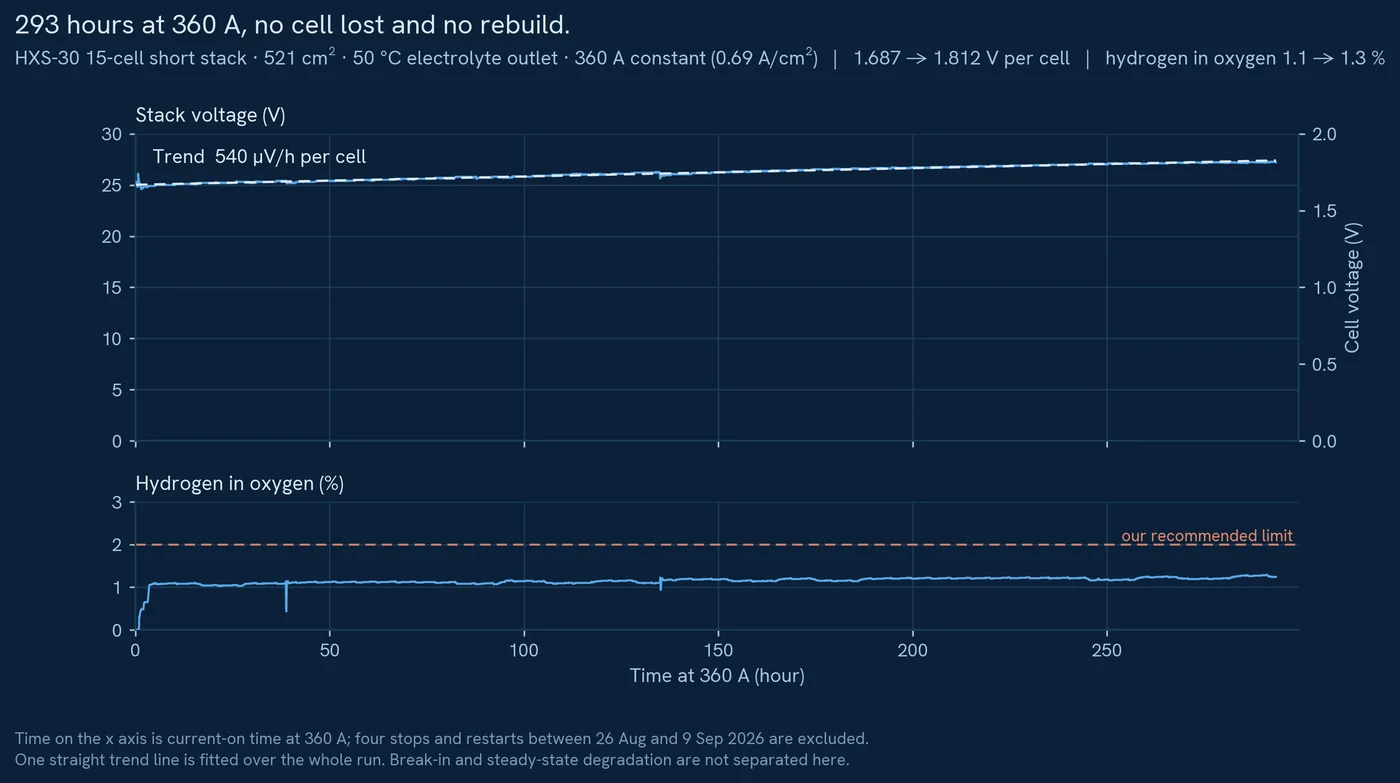
Stack voltage stayed between 25.3 V and 27.2 V — 1.687 V to 1.812 V per cell. The vertical axis starts at zero so the rise can be read against the absolute value it sits on.
Hydrogen in oxygen started at 1.1 % and reached 1.3 %, against the 2 % limit we recommend. That is 0.2 percentage points over 293 hours. If a membrane were failing, this is the signal that moves first. It did not.
Temperature held at 50.0 °C throughout, with segment means within 0.1 °C of each other. Cooling and circulation work as intended at fifteen cells, and the voltage rise cannot be explained by thermal drift.
The stepped look of the voltage trace is logging resolution: stack voltage is recorded to 0.01 V, which is 0.7 mV per cell across fifteen cells.
3. What this run confirmed
- **No cell dropped out.** Over 293 hours no single cell collapsed. Distribution is the first thing that breaks when you add cells to a short stack.
- **Thermal control works at fifteen cells.** Outlet temperature did not leave 50.0 °C.
- **Crossover is stable and well under the limit:** 1.1 → 1.3 % hydrogen in oxygen, never past half of what we recommend.
- **Restarts reproduce.** Four stops and four restarts, and each time the voltage returned to the existing trend line. Loosening compression during operation would leave a step here.
This is the longest continuous run we have done at 30 kW scale.
Counting the balance of plant, what this run means is that a 30 kW-class stack can now be kept running for two weeks rather than sitting idle. All four stops came from the plant side, not the stack, and each time it restarted.
4. What remains open: the rate of voltage rise
A single straight line fitted across the whole run gives 540 µV/h per cell. This is the disappointing number in the run.
The comparison is our own 2 kW stack. Run at ambient pressure for 2,281 hours, HXS-2 degraded at 80 µV/h per cell — the figure we published in our first technical note. 540 µV/h is more than six times that.
Two explanations are open. One is break-in: a new stack moves quickly for the first few hundred hours and then the slope falls. The 80 µV/h from the 2 kW stack is itself a fit over 2,281 hours, and its early window was steeper. The other is that a larger cell genuinely degrades faster.
293 hours cannot separate the two. If it is break-in, the slope will bend down over the next several hundred hours. If it is degradation, the line continues straight. The only way to find out is to keep running, which is what we are doing.
We did not look for a window that flatters the number. One straight line, fitted over the whole run.
5. Next
The 46-cell full stack completed its first operation in September 2026. We carried both what fifteen cells confirmed and what they did not.
The HXS-30 46-cell full stack is available now. The 46-cell results will be written up the way this note was: conditions and the full window together, and whatever we could not verify stated as not verified.
Every figure here comes from one stack and one run. Until a second run under the same conditions reproduces it, please read it that way.
- HXS-30 · 30 kW stack→
- Note: our first large-area cell was worse than the stack we already sell→the record up to the first 15-cell run
Need the detailed durability graphs and i-V test conditions?