A coated particle layer starts with a large, accessible surface, so the first current density looks good. Keeping that surface attached to the substrate is a different problem, and it is the one that decides how long the cell runs. Set out here with a 6,358-hour HydroXpand run on a 16 cm² two-cell short stack.
There are two ways to get catalyst onto an electrolyzer anode. You can make the catalyst as a powder, mill it into an ink with an ionomer binder, and coat it onto the substrate. Or you can grow the catalyst out of the substrate itself, so that there is no binder and no boundary between the two.
The first route is the more common one, and on a fresh cell it often measures better. A milled powder has a large specific surface area and the ink can be tuned until the initial current density is high. If you compare two anodes on the day they are built, the coated one can win.
The question this note is about is what happens after that day.
A large surface is worth nothing if it does not stay attached to the metal underneath it.
1. What actually removes the catalyst
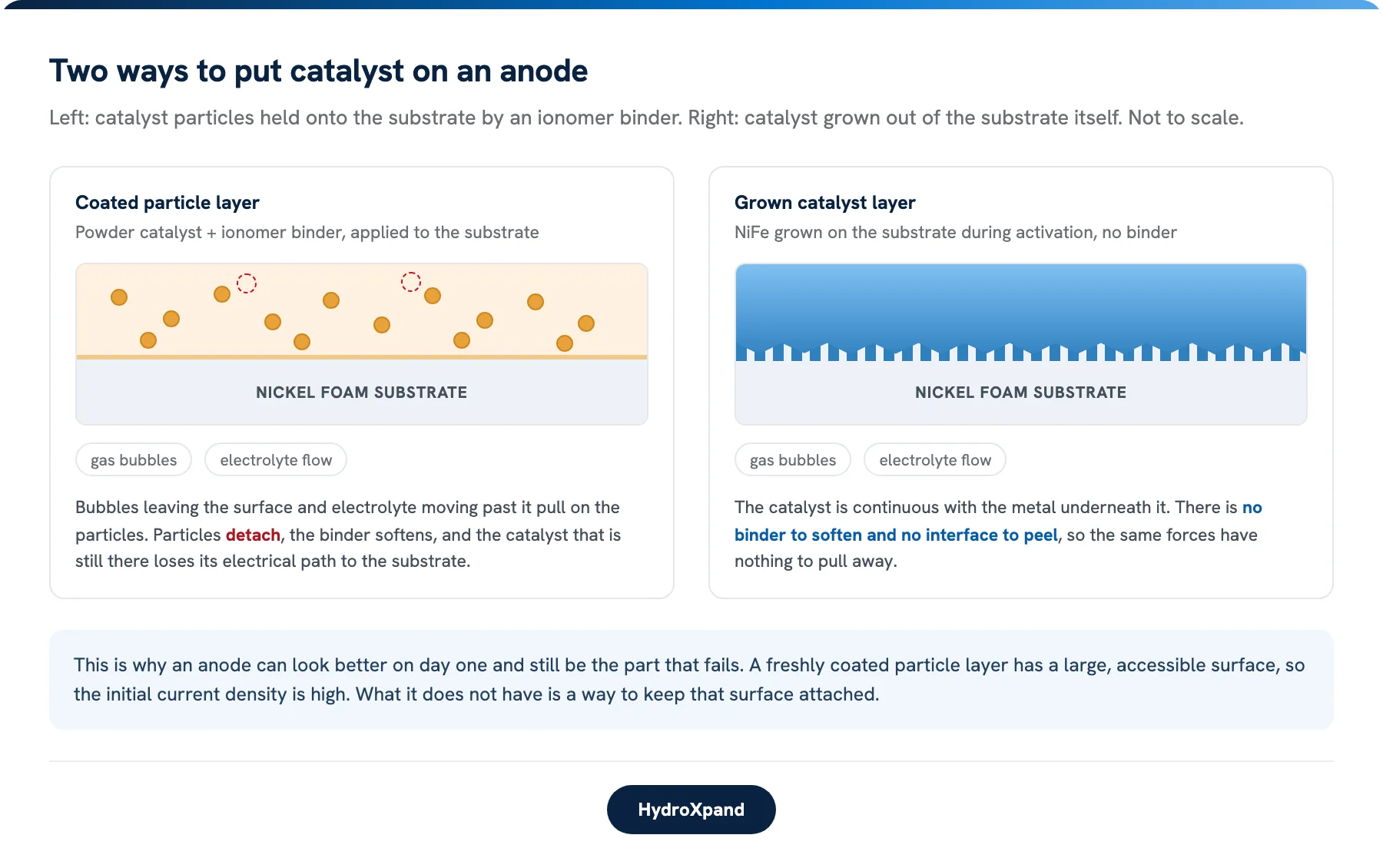
An operating anode is not a quiet place. Oxygen forms at the catalyst surface, grows into bubbles, and leaves. Electrolyte is pumped past the same surface for the whole life of the cell. Both of those apply mechanical force to whatever is sitting on the substrate.
In a coated layer, the catalyst particles are held in place by an ionomer or binder. That binder has to do two jobs at once: hold the particles mechanically and carry hydroxide to them. Under continuous bubbling and flow, particles work loose and leave. What remains can still be catalytically active and yet contribute nothing, because it has lost its electrical path back to the substrate.
There is a second problem that shows up at production scale rather than in a laboratory cell. A porous substrate several millimetres thick cannot be coated uniformly all the way through, so the catalyst sits mostly near the outer surface, which is also where the mechanical forces are highest.
A grown layer does not have the same failure path. The catalyst grows on the metal substrate itself and is continuous with it. There is no binder to soften and no interface to peel, so the bubbles and the flow have nothing to pull away.
2. What the published durability data looks like
The mechanism above is an argument. The distribution below is what other laboratories have reported.
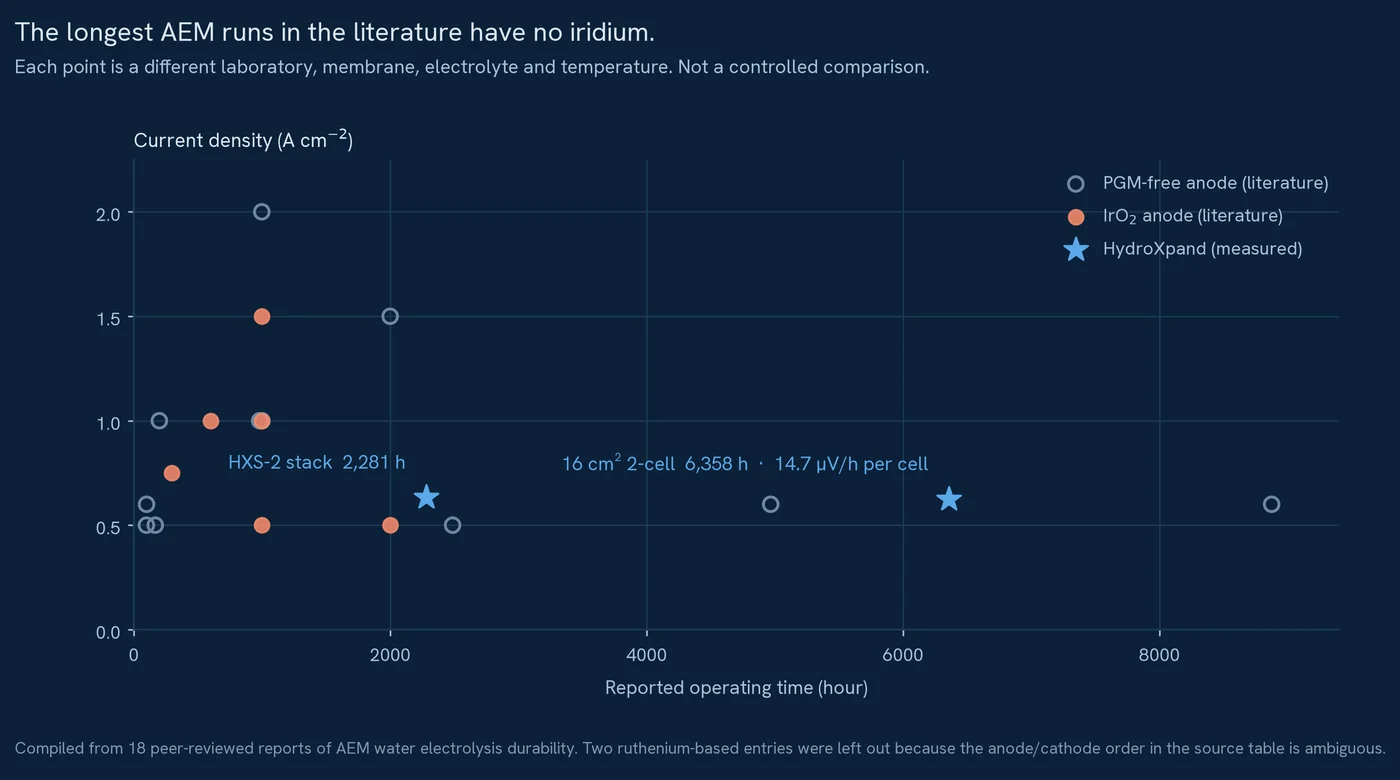
Two things are worth reading off this chart, and a third is worth reading into it carefully.
First, the reported iridium-oxide runs cluster below 2,000 hours, while the runs that reach 4,968 and 8,875 hours use nickel-iron and copper-cobalt oxide anodes with no platinum-group metal at all. In alkaline conditions, iridium is not what makes a cell last.
Second, hours alone are a poor measure. The 8,875-hour report ends at 2.89 V at 0.6 A cm⁻², which is a cell that has largely stopped being useful. A long run is only meaningful next to the voltage it ended at and the rate it got there.
Third, and this is the honest limitation: every point is a different laboratory, membrane, electrolyte and temperature. This is a distribution, not a controlled comparison. We do not have a side-by-side long run of a coated anode and a grown anode in the same cell, and we are not going to imply that we do.
One more thing about what this chart does not separate. It splits anodes by whether they use iridium, while the coated-versus-grown distinction above is about form rather than composition. An IrO₂ anode is both at once. Separating the two would take the same NiFe in identical cells, coated in one and grown in the other, run side by side over a long test.
- HXP-an · anode→Grown on the substrate, no binder.
- Datasheets→Six products. No form.
3. Our own measurements
The two stars on that chart are ours, and both are galvanostatic runs with a grown nickel-iron anode.
The membrane matters as much as the anode, and pretending otherwise would be dishonest. In that same short-stack campaign, a different membrane reached 1,234 hours rather than 6,358. The anode is not the only variable, and a durability number belongs to a whole cell, not to one component in it.
We also publish the rate rather than only the hours, because the rate is the part that transfers to a different run length. The two figures above were fitted across the full run in both cases, which is the conservative choice: an early window pulls the number up, and quoting a late window flatters it.
What to check when you choose an electrode
- A first-day polarisation curve tells you about surface area and ink quality. It does not tell you how the electrode is attached, which is the part that decides the second thousand hours.
- Ask how the catalyst is bonded to the substrate. Coated with a binder, or grown on it. Both are used in commercial products, but they fail differently and only one of them has a binder in the failure path.
- Ask for conditions with every number. Electrolyte concentration, temperature, current density, membrane, cell area and the fitting window. A degradation rate without them cannot be compared with anything.
- Treat hours and rate as one figure. A run that lasts 8,000 hours and ends near 2.9 V is not better than one that lasts 6,000 and ends at 1.98 V.
Ask for the voltage the run ended at, the rate it got there, and the window that rate was fitted over.
Our anode is nickel-iron grown directly on nickel foam, with no binder and no platinum-group metal. That choice was made for durability and cost rather than for the first measurement, and the trade is real: on a fresh cell, a well-made iridium-oxide anode will still give a higher current density at the same voltage. We would rather publish that than have you find it out yourself.
- Reading stack durability data→Note 1. How to read a long-run curve, and cell-to-cell spread.
- What changes when you run the stack at 10 bar→Note 2. The voltage cost of pressure and what crossover really bounds.
- HXP-an anode→Architecture, test data, standard formats and supply terms.
Need the detailed durability graphs and i-V test conditions?